Israel Palestine video – Jewish voice for peace

      Comments Off on Israel Palestine video – Jewish voice for peace
The
following video comes from Jewish Voice for Peace, which has a similar
call as mine – Security for Jews and Justice for the Palestinians. The
site claims, “Watch this short, historically accurate animated
introduction to Israel-Palestine 101” – 
I
believe Miko Peled’s history has a slight variation in its narration of
history, the Palestinians did not accept the mandate because a majority
of the living population were given a small piece of land, where as the
majority of the land was given to the a minority Jews.  However,
between Miko Peled’s history and this, varies on the Arab invasion. 
Indeed, my understanding of the entire conflict is laid out in my article, http://nabsites.net/demo/how-to-achieve-security-for-israel-and/
Here is the version by Jewish voice for peace.
 
———-
Mike Ghouse is a speaker, thinker and a
writer on pluralism, politics, peace, Islam, Israel, India, interfaith, and cohesion at work
place and standing up for
others
as an activist. He is committed to building a Cohesive America and offers
pluralistic solutions on issues of the day at www.TheGhousediary.com. Mike has a
presence on national and local TV, Radio and Print Media. He is a frequent guest
on Sean Hannity
show
on Fox TV, and a commentator on national radio networks, he contributes
weekly to the Texas Faith Column at Dallas Morning News, fortnightly
at Huffington post, and
several other periodicals across the world. His personal site www.MikeGhouse.net indexes everything you
want to know about him.


Janambhoomi-Babri Ayodhya – The Battle for India India's soul – 3

      Comments Off on Janambhoomi-Babri Ayodhya – The Battle for India India's soul – 3

AYODHYA, THE BATTLE FOR INDIA’S SOUL – 3
URL: http://mikeghouseforindia.blogspot.com/2012/12/ayodhya-battle-for-indias-soul-3.html

Thanks to Wall
street
Journal and
Krishna Pokharel and
Paul Beckett for writing the series on the topic, it is one of India’s
unfinished social business and needed to be
addressed. The article follows my
commentary.

 ……

 Here is Chapter 3 of the 6 on
the Battle for India’s soul. The authors Mr. Pokharel and Beckett have done a
great job of storytelling,  I do hope, most of us Indians are reading this
as objectively as it is written, first to understand the full complexity of it,
then be ready to find a solution – that is both Hindus and Muslims can live
with. Neither should be pushed around, historicity is not the issue; the issue
is dealing with flared up emotions.

We are human, and one of the greatest telling in this story is the human
spirit; no one wants to be pushed around, and no one wants to be cornered or
dumped a decision on them.  Had the Planters of Ram Lallah consulted
with Muslims, the outcome would have been different, as opposed to sneaking in
the statue in to the Mosque, knowing well that was the wrong thing to do in the
name of God.
 Think about this, seriously
think about this, if parties were called in to discuss with free choices, we
probably would have found a solution long time back.  In national
dialogues, people are called in to talk without conditions and it makes sense.

On
the conversion front, it is a sour subject, it should not be.  We need
to seriously think: Shouldn’t we have complete freedom in what we drink,
eat, wear or believe? What should be regulated is when we we steal,
rape, lie,  murder, break the agreements or infringe upon each others
right. Every Indian should be free to become a Hindu, Muslim,
Christians, Atheist or whatever he or she chooses. Do you subscribe to
this? Forget about others, do you subscribe to the idea of freedom?

Both Hindus and Muslims are
agitated for lack of acceptable choice, of course, a few on both sides don’t
care about the other, it is their own feelings, a sense of security they care.
Has that produced results? Justness is the only thing that binds and sustains a
society in the long haul. We have to take the steps and decide, and hold on to
the damned temptations to shove it on the other. We have to bring resolution to
this, and cannot pass it on to the generation; lets’ leave them to focus on
prosperity and living their lives.

 As Patriotic Indians, who
care about a better and peaceful India, not an India of harassing each other,
we need to find an amicable solution, even if it takes a lot of pain and
frustration. Once a decision is made with free and willing parties, the
decision will last, and the next generation can focus on better things of life.

At this moment, if you feel like blaming one of the other, than you are the
wrong person to be in the decision making process and need to let others do it
for the sake of India and the future of next generation.

Jai Hind

Mike Ghouse
for India’s Pluralistic ethos
http://MikeGhouseforIndia.Blogspot.com

………………………………………

Ayodhya, the Battle for India’s Soul: Chapter Three

By Krishna Pokharel and Paul Beckett
Courtesy – http://blogs.wsj.com/indiarealtime/2012/12/05/ayodhya-the-battle-for-indias-soul-chapter-three/

Paul Beckett/The
Wall Street JournalA painting on a Muslim house in
Meenakshipuram, Tamil Nadu. Click here
to view related slideshow.

In the 1980s, the Ayodhya dispute escalated from a local issue to a national
one. It fed, and was fed by, other points of tension in Indian politics and
society that set Hindus and Muslims on a collision course over the span of the
decade.

Each side came to feel that its religion and status in India was under threat
– and both sides responded with political pressure and shows of force.
It started in 1981 in Meenakshipuram, an unremarkable village deep in the
countryside of the southern state of Tamil Nadu, more than 2,000 kilometers from
Ayodhya.

The village hit the national news when its low-caste Hindus – about 400
families, villagers say — converted, en masse, to Islam.

“We became Muslims to become equal,” said 65-year-old N. Hidayathullah, one
of the converts, in an interview on the porch of his modest home, as a herd of
goats wandered by.

The families had felt ill-treated by local upper-caste Hindus, he said.
“Nobody told us to convert; it was our desire to be treated with respect,” he
added.

**

Vishwa Hindu
ParishadSadhus during the 1984 dharma
sansad

At stake was more than belief: In India, how you worship defines your
community, most likely your marriage and whom you vote for, your approach to
life, and your identity.

In 1984, Hindu leaders responded to what they viewed as the threat of Islam
emanating from the Meenakshipuram conversion.

About 500 sadhus — Hindu holy men — from across India gathered at Vigyan
Bhavan, a government-owned conference center in New Delhi. They comprised a
“dharma sansad,” or religious parliament.

The meeting was put together by the Vishwa Hindu Parishad, a conservative
Hindu organization founded in the 1960s. The chief organizer was Ashok Singhal,
then the VHP’s joint general secretary.

Krishna
Pokharel/The Wall Street JournalAshok Singhal
today

The son of a government official in Agra, home of the Taj Mahal, Mr. Singhal
graduated with a degree in metallurgical engineering from Banaras Hindu
University in 1950. Now 86 years old, he has worked to promote Hindu causes ever
since. “Our culture is under siege,” he said in an interview at the VHP’s
offices in New Delhi.

The religious parliament began with a song by a group of musicians. “This
country’s soil is sacred,” they sang, according to a later account of the event
published by the VHP. “Every girl is an image of a goddess, every boy is
Ram.”

After a sadhu blew a conch shell, speeches began. Among the speakers was
Karan Singh, a former minister in Prime Minister Indira Gandhi’s cabinet. At the
time, he was an independent member of Parliament. Courtly and soft-spoken, he is
the son of the last Maharaja of Jammu and Kashmir.

Mr. Singh was the founder of an organization to espouse the values of
universal brotherhood and human welfare contained in the Vedas and Upanishads,
Hindu sacred texts. He formed it in direct response to the events of
Meenakshipuram, he said in an interview in the book-lined study of his Delhi
mansion.

The mass conversion to Islam “was, first of all, a clear statement that the
way Hinduism was functioning is not acceptable to a large number of people,” Mr.
Singh said. At the time, the message was: “People are leaving because we are not
following our principles.”

At the religious conference, Mr. Singh spoke about the need to reconnect
individual life and politics with the tenets of Hinduism, and to rid society of
the dowry system and the stigma of “untouchability” that relegated lower-caste
Hindus to an underclass, according to the VHP’s account of the event. He also
rued the fact that Hindu holy sites had been neglected.

Vishwa Hindu
ParishadKaran Singh, at the center,
during 1984 dharma sansad

“We cannot even light a holy lamp” at Ram’s birthplace in Ayodhya, he told
the sadhus. “How shameful a matter is it for 80% of this country’s residents who
call themselves Hindus?”

The gathering issued a code of conduct for individuals, families and society.
Its code for the country’s statesmen included the demand that three important
holy sites be “given back to Hindu society.”

The Babri Masjid, the mosque in Ayodhya that many Hindus claimed was Lord
Ram’s birthplace – “Ram Janmabhoomi” in Hindi — was top of the list.

Ram appealed to Hindus of all castes: one story recounted in the Ramayan, the
text about his life, has him happily eating berries given to him by a
lower-caste woman.

A few months after the religious parliament, the VHP followed up with a rally
for devotees led by a motorized chariot. Hindu scripture says Ram rode a chariot
into battle.

The rally started at Sitamarhi in Bihar in late September 1984. The district
is believed by Hindus to be the place where Sita, Ram’s wife, emerged from the
earth.

Vishwa Hindu
ParishadThe 1984 rally from Sitamarhi
to Ayodhya.

Thousands of the faithful joined the procession, which reached Ayodhya 12
days later. There, they descended to the banks of the Sarayu river, cupped its
water in their palms and, according to several participants, took an oath.

The crowd totaled about 50,000 that day, according to Mr. Singhal of the VHP,
who was among them. Similar oath-taking ceremonies were held at major rivers
around the country.

The Hindus at the Sarayu that day wanted to go further than keeping a tiny
statue of Ram inside the Babri Masjid. They wanted to build a house of worship
where Ram sat: “We will give up everything to build Lord Ram’s temple at his
birthplace,” they swore, according to several people who took part.

The organizers say they were surprised by the number of supporters. “People
found that this is an agitation which will be successful,” Mr. Singhal said.
“Such a large number of people came from small villages to witness and join the
movement.”

A day later, the chariot started rolling again. But its journey was
interrupted when, on Oct. 31, 1984, Mrs. Gandhi, the prime minister and
Jawaharlal Nehru’s daughter, was shot dead at her New Delhi home by two Sikh
bodyguards.

Soon, Ayodhya would become a defining issue for the country’s new leader:
Mrs. Gandhi’s 40-year-old son, Rajiv.

**

Rajiv Gandhi was a political beginner. Eschewing politics, he worked as
a pilot for Indian Airlines and married an Italian, Sonia Maino.

Agence
France-Presse/Getty Click here
for an overview of key players in chapter three.

He was elected as a member of Parliament in 1981, following the death of his
younger brother, Sanjay, in a plane crash. Soon after Mr. Gandhi succeeded his
mother, he called for national elections. His Congress party won the biggest
Parliamentary majority in India’s electoral history.

Mr. Gandhi brought the promise of a new kind of Indian leader. He was young
and interested in promoting technology. Within months, however, he was deeply
embroiled in the historical tussle between Muslims and Hindus and the sense of
victimhood that both sides felt.

The catalyst was a case brought by a Muslim woman called Shah Bano. She had
been divorced by her husband several years before and was left destitute. She
asked the Supreme Court to force her ex-husband to pay maintenance.

In the spring of 1985, the Supreme Court ruled in her favor, citing the
provisions against destitution in Indian criminal law that applied to all
Indians.

Prominent members of the Muslim clergy viewed the ruling as a threat to
Islamic law, which had long governed their personal matters. It does not require
the equivalent of alimony. But the justices had ordered a divorced man to pay
maintenance.

At first, Rajiv Gandhi backed the verdict. Arif Mohammed Khan, a Muslim and
minister in Mr. Gandhi’s government, made a long speech in Parliament in praise
of the ruling.

In an interview, Mr. Khan said he did so at the prime minister’s request.
Afterward, he received a note from Mr. Gandhi, he said, which congratulated him
on a “wonderful performance” and a “great speech.”

But the Muslim clergy protested, heaping pressure on the prime minister. They
demanded he counter the verdict through an act of Parliament. “The Muslim clergy
found this as an opportunity to mobilize the Muslims and project themselves,”
said Mr. Khan.

Mr. Gandhi succumbed and started preparations for a law that would
effectively overturn the Supreme Court ruling.

But he also wanted to find a way to mollify Hindu outrage over the Muslim
protests and to counter anticipated Hindu claims that Muslims were being
appeased by the government, said Mr. Khan.

The prime minister, he said, found his answer in a court case in Faizabad,
the city next to Ayodhya.

The case sought to have the lock removed on the main gate of the Babri
Masjid, granting greater public access to the idol that had been sitting in
seclusion under the central dome for almost four decades.

Mr. Gandhi’s calculation, Mr. Khan said, was that the Hindu focus on the Shah
Bano case “will be redirected to Ayodhya.”

**

Krishna
Pokharel/The Wall Street JournalUmesh Chandra Pandey at his
residence in Lucknow.

Umesh Chandra Pandey filed the petition to open the lock in late January
1986. He was a 30-year-old lawyer and occasional journalist who then lived in
Faizabad.

His interest in the issue had begun three years earlier, when the editor of a
local Hindi newspaper asked him to write a feature on the festival commemorating
Ram’s birthday, Mr. Pandey and the editor said in interviews.

Mr. Pandey said he also heard leaders from the Vishwa Hindu Parishad claiming
that there never had been an official order to lock the Babri Masjid gate.

“I thought, ‘If this is so, then how has this lock been put there?’” he
said.

Adding drama and urgency, a prominent sadhu had threatened to set himself
ablaze if the lock was not removed, according to Mr. Pandey and other accounts.
Other sadhus threatened to get themselves arrested by trying to unlock the gate
themselves, according to the VHP’s Mr. Singhal.

Mr. Pandey, a short man who speaks in emphatic phrases, said he spent a
couple of weeks examining court papers. He came to the conclusion that there had
never been a formal order putting the lock in place, he said. (Priests who cared
for the idols in the building entered through a side gate.)

Soon after Mr. Pandey filed his petition, he found out that a copy had
been sent to the state agency in charge of internal security, he said.

Paul Beckett/The
Wall Street Journal

The petition also attracted the interest of Rajiv Gandhi and Arun Nehru, a
cousin of Mr. Gandhi’s and a powerful adviser to the prime minister, according
to Arif Mohammed Khan, the government minister at the time.

Mr. Gandhi and Mr. Nehru wanted to ensure that the petition succeeded so
Hindus would feel assuaged, Mr. Khan said. The prime minister asked Mr. Nehru to
coordinate the government’s participation in the case, including dealing with
the state government of Uttar Pradesh, Mr. Khan said.

Other officials from the time say Mr. Nehru, the adviser, was the more
influential in seizing on the issue and the prime minister acquiesced. Yet
others say Mr. Gandhi was unaware of what was happening.

Either way, said Mr. Khan: “The buck stops at the door of the prime minister”
as the head of the government.

When asked about the episode in a brief telephone conversation, Mr. Nehru
responded: “That’s none of your damn business.”

The government ensured that two senior local officials appeared – unusually —
before the judge, rather than submitting affidavits, Mr. Khan said. They
testified that law and order could be maintained if the lock was removed, a key
consideration in the judge’s deliberations.

Mushtaq Ahmad Siddiqui, one of the lawyers representing Muslims in their
legal claims to the Babri Masjid site, said he also asked to be heard before the
judge.

“You may, there is no hurry,” he said the judge responded. “The matter is
continuing for 36 years – you will be allowed sufficient time.” He was referring
to the fact that litigation over the site had begun in 1950.

On the afternoon of Feb. 1, 1986, the judge ruled there had been no official
order that placed the lock on the mosque’s gate. He ordered the lock opened
“forthwith,” according to witnesses. The judge is now deceased.

Within 30 minutes, a senior police officer in Ayodhya broke the lock. A
camera crew from Doordarshan, the government-run television channel, was there.
The event was broadcast to the nation.

Mr. Pandey, the man who filed the petition, said he couldn’t sleep that
night. The next morning, he went to the site.

“I was without words,” he said. “But I was thankful to God that I was able to
look and to offer my prayer.”

The gate opening was the first that millions of Hindus had heard of Ayodhya
and the battle over Ram’s birthplace. It energized them en masse because Ram was
a role model. 

Grandmothers told their grandsons to aspire to be like him:
obedient to their parents, faithful to their family, honest in their
dealings.

Mani Shankar
AiyerRajiv Gandhi, right, in an
undated photo with Mani Shankar Aiyer.

Rajiv Gandhi received the news during a visit to the Maldives, according to
Mani Shankar Aiyar, his speechwriter at the time.

In the hours before a state banquet, the prime minister was putting the
finishing touches on his formal dress and on his speech when he received a
telephone call, Mr. Aiyar said in an interview. Mr. Gandhi was told the lock was
opened, Mr. Aiyar said.

The lock opening quickly took on a mystical aspect. Mr. Pandey claimed that
on the afternoon of the decision, a monkey sat on the roof of the Faizabad court
house. A monkey was symbolic because Hanuman, the Hindu monkey god, was a loyal
friend of Ram.

The animal, unusually for a monkey, sat still for more than 30 minutes, Mr.
Pandey said. Then, when the judge issued his order, the monkey walked to the
flagpole on the courthouse roof and touched the Indian flag, according to Mr.
Pandey. “I don’t think this can happen without the Almighty’s permission,” he
added.

**

The lock opening shocked Muslim elders and lawyers who had been following the
Ayodhya dispute because they saw in it a threat to their mosque and to their
religion. They gathered the next day in an orphanage in Delhi.

“Today, it appears we have become second-class citizens,” said one elder,
close to tears, according to two people who were there.

The leaders worried that the next step would be the Babri Masjid’s
destruction.

On Feb. 3, 1986, two days after the lock was opened, a small group of Muslim
lawyers petitioned the high court in Lucknow, the capital of Uttar Pradesh, to
order that nothing more happen to the site, according to two of the lawyers.

The judge issued a notice that the “status quo” be maintained.

Zafaryab
JilaniZafaryab Jilani in the
mid-1980s

Zafaryab Jilani, one of the lawyers, was then just shy of his 36th
birthday. The lock opening would vault him to the forefront of the Muslim
movement seeking to retain the Babri Masjid site for Islam.
Born in a town close to Lucknow, Mr. Jilani pursued his legal studies at
Aligarh Muslim University.

There, he gained his first experience in organizing protests. He said he was
part of a small group that, in 1970, led students in opposing government plans
to commemorate the 50th anniversary of the school’s incorporation by
an act of Parliament.

The students were angry about previous government measures that stopped
Muslims from being the sole administrators of the university. Faced with the
protests, the government scrapped the golden jubilee festivities and,
ultimately, undid the administrative changes.

After the Babri Masjid lock opening, Mr. Jilani started organizing protests
again.

He and a handful of associates called meetings of prominent local Muslims; it
included one gathering of about 200 in a hall in Lucknow, Mr. Jilani said in an
interview.

They created the Babri Masjid Action Committee to organize public strikes and
demonstrations– and to push back against what the leaders viewed as Hindu
aggression.

On Feb. 7, 1986, Mr. Jilani said he and about eight others met the then-chief
minister of Uttar Pradesh, Vir Bahadur Singh. The chief minister denied any
involvement in the lock opening, Mr. Jilani said.

“I haven’t done it. Whatever has been done, it is at the behest of some other
leaders, top leaders,” Mr. Jilani said the chief minister told them. Mr. Singh
died a few years later.

A week after that meeting, the new committee held its first event: a “Black
Day,” or state-wide public strike, Mr. Jilani said. Later, tens of thousands
protested in Lucknow and other cities.

**

In May 1986, the government used its huge majority in Parliament to push
through a law that effectively reversed the Shah Bano ruling and made it clear
Muslim personal law would prevail.

Mr. Gandhi’s supporters say the prime minister was only trying to clarify
that matters of Muslim personal law would be governed by Islam, as they had been
for decades.

The law’s passage cemented the idea among many Hindus that the government was
kowtowing to Muslims. Muslim leaders, on the other hand, were angry about the
lock opening. The prime minister’s plan to do something to mollify both sides
had gone awry.

Arif Mohammed Khan, the minister who had supported the Shah Bano ruling,
resigned from the government. He recalled that Mr. Gandhi said to him at the
time: “The situation is such that I am feeling very helpless.”

And, as Mr. Gandhi’s grandfather, Prime Minister Jawaharlal Nehru, had feared
in 1950, the new prominence of the Babri Masjid dispute complicated the delicate
political equation in the late 1980s in Kashmir, the Himalayan region fought
over by India and Pakistan.

Militants who favored a separate country of Kashmir used the opening of the
lock on the mosque to rebuke Indian Muslims who favored embracing India’s
secularism and democracy.

The militants said, according to Mr. Jilani: “Your government is not sincere
with you, how do you expect that government to be sincere with us?”

Tomorrow: The
last chances at a settlement slip away.

Janambhoomi-Babri: Ayodhya – The Battle for India India's soul – 2

      Comments Off on Janambhoomi-Babri: Ayodhya – The Battle for India India's soul – 2

AYODHYA – THE BATTLE FOR INDIA’S SOUL – 2 OF 6 :
http://mikeghouseforindia.blogspot.com/2012/12/ayodhya-battle-for-indias-soul-2.html

Thanks to Wall
street
Journal and
Krishna Pokharel and
Paul Beckett for writing the series on the topic, it is one of India’s
unfinished social business and needed to be
addressed. The article follows my
commentary.

 ……

 This
is 2nd in a six part series on Ayodhya, “RamTemple-Babri Masjid
conflict”  by the Wall Street Journal. It is one of the few unresolved
conflict’s of India.

Thus
far, both the pieces have been objective, causing people think in
finding a solution with least conflicts,  and with a least sense of
injustice. No one can bulldoze others’ sentiments and expect peaceful
existence, one may get away temporarily, but the apprehension endures
for both sides, unless they live in a bucket.  We have to have a
heart-to-heart in a national dialogue to put this behind and move
forward. If you have ill-will toward me, and vice-versa, both of us are
victims of our own ignorance.

Fox example, many Muslims,
including this Muslim continues to condemn the atrocities of Aurangzeb
and the plunderer Mahmood Ghazni of Somnath fame. Even though I have
nothing to do with them, nothing to gain, I did not even inherit a kaas
from their loot,  yet I am looked up as one of them, as if I am
responsible for their acts. No,  I am not responsible for any of those
acts from the history.

As an Indian, whether I am a Hindu,
Muslim, Sikh, Christian, Jain, Buddh, Maratha, Pandava, Pallava, Peshwa,
Gujarati, Punjabi, Sindhi, Bengali or Malayalee. I am not responsible
for the massacres during the partition, yet, you and I, are held
responsible in the psyche of many. We all need Mukti from it and cannot
continue to live in ill-will and hatred for the other. We have to end
this cycle in our Janam and be free. We have to have a real national
dialouge where we feel our forgiveness of each other is genuine, and it
would be, if it would give us mukti. Are we really free?

What I am responsible for then? 

I
am responsible for those acts that have happened during my life time,
and where the least I could have done is spoken up against Indira
Gandhi’s brutal emergency rule, spoken out against communal riots
regardless of whom we blame, spoken out against the exodus of the
Kashmiri Pandits, the massacre of the Sikhs, Gujarat Massacre, burning
of Dalit Villages, raping of the Nuns, the suicide of farmers…. and
you can list more things here (page is not enough).

Our grand
Kids can look up and ask? Dada or Dadee, did you speak out when wrong
things were happening? Why did you pass the buck to us? Did you tell Mom
and Dad that “the others” were wrong and filled their hearts with
hatred for the other? Were you not capable of finding solutions? Did you
just blame everyone else than yourselves?

The looting they did
was for their own personal gain, that is what those kings did; whether
Muslim, Christian, Sikh, Buddhist or other kings, they had nothing
better to do than loot and annex the next state or next door city. Most
of the Kings were just fighting wars, very few had time to encourage
education, knowledge, translate book, focus on Music, improve medicine,
share knowledge… that benefits the general public for generations to
come.  There were good, bad and ugly Mogul, Pallavas, Singhs, Peshawas,
Khiljis, Tughlags, British and you can add a whole lot of them to the
list.  or any one in the past, with a few exceptions. Are you and I
responsible for the acts of those? If not, we should purge the latent
ill-will from our hearts, it is for our own individual good.

“This
issue will not go away” they said that sixty years ago about Ayodhya.
If you and I are irresponsible like them, we will repeat it, or find a
solution and not pass this to our next generation. The solution is not
easy, we have to listen to each others fears and aspirations, but
dialogue, we must.

I do hope, we
clean at least our own hearts and minds – for our own peace of mind. I
know we can do it, and I know many Indians are doing that now. Clean it
up, and see the moksha you find, it is all within you and you can do it.

Enjoy the freedom

Jai Hind

Mike Ghouse for India’s Pluralistic ethos
http://MikeGhouseforIndia.Blogspot.com 
 

………………………………………

Ayodhya, the Battle for India’s Soul
By Krishna Pokharel And Paul Beckett

http://blogs.wsj.com/indiarealtime/2012/12/04/the-battle-for-indias-soul-chapter-two/

[This Wall Street Journal investigation is being published in
serialized form. A new chapter will be posted each morning this week on
India Real Time. Click here to read chapter one and three.]

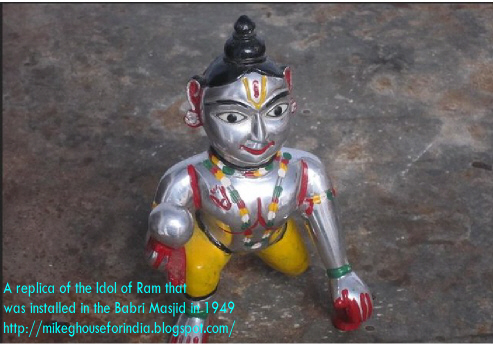
Paul Beckett/The Wall Street Journal. A replica of the idol of Ram placed in the Babri Masjid on Dec. 22, 1949. Click here to view related slideshow.

Jawaharlal Nehru, India’s prime minister, was greatly perturbed by an idol of Lord Ram being placed in a mosque.

Jawaharlal Nehru, left, with U.S. President Harry Truman.

Polished, intellectual and skeptical of religion, Nehru was trying to
propel the nation into an era of modern socialism and scientific
thinking. But the events in Ayodhya forced him to grapple anew with the
centuries-long friction between Hindus and Muslims – and to try to
counter the spreading belief that a deity had materialized in the dead
of night.

“I am disturbed at developments at Ayodhya,” Nehru said in a telegram
on Dec. 26, 1949, to Govind Ballabh Pant, chief minister of United
Provinces, which roughly included what is now the state of Uttar
Pradesh. “Earnestly hope you will personally interest yourself in this
matter. Dangerous example being set there which will have bad
consequences.”

The provincial government wanted the statue removed. K.K. Nayar, the
district magistrate in Faizabad, who also oversaw Ayodhya, refused. He
wrote to a provincial official that removing the idol was “fraught with
the gravest danger to public peace” and would lead to a “conflagration
of horror,” according a copy of his correspondence.

Around that time, Guru Dutt Singh, the city magistrate, resigned. His
son, Guru Basant Singh, said his father quit because “his work was
done” and the idol’s installation, which Mr. Singh helped plan, had
succeeded.
Local Hindus added religious items to the mosque: more idols; six
black ammonite stones; a small silver throne; brass utensils for
worship; and clothes for the deity, according to an official list
compiled later.

Muslims weren’t welcome. Mohammad Hashim Ansari, a local tailor,
headed to the Babri Masjid with a few others the morning after the idol
of Ram was installed, said Mr. Ansari and another local Muslim who was
there. The police stopped them at the gate. The Muslims returned home,
they said.

Nehru kept pushing. In early January, he wrote again to Mr. Pant. The chief minister called him soon after.

Mr. Pant “intended taking action, but he wanted to get some
well-known Hindus to explain the situation to people in Ayodhya first,”
Nehru wrote in a separate letter to the governor-general of India dated
Jan. 7, 1950.

Weeks passed. The idol stayed.

The Wall Street Journal/Court FilesThe idols installed in the Babri Masjid in 1949, shown in a photo taken in 1950.

The discord in Ayodhya threatened Nehru’s desire for India to be a
democracy in which all beliefs were equally respected. He also feared
that it would have repercussions “on all-India affairs and more
especially Kashmir,” the disputed territory between India and the
newly-created Pakistan, he wrote to Mr. Pant on Feb. 5, 1950.

Nehru added that he would be willing to make the 600-kilometer trip
from Delhi to Ayodhya himself. But, he also noted, “I am terribly busy.”

Nehru didn’t make the trip. By March, he was sounding defeated as local officials continued to balk at removing the idol.

“This event occurred two or three months ago and I have been very
gravely perturbed over it,” he wrote in a letter to K.G. Mashruwala, an
associate of Mahatma Gandhi.

Nehru lamented that many in his Congress party had become “communal”
toward Pakistan and India’s Muslims. “I just do not know what we can do
to create a better atmosphere in the country,” he wrote.

In 1952, Nehru visited Uttar Pradesh to campaign for Mr. Pant in an
election, according to a person who heard him speak. He told the crowd,
in Hindi, “The Ayodhya event has put me to shame,” this person said.

**

In January 1950, a decades-long legal battle began between
Ayodhya’s Hindus and Muslims over the site of the Babri Masjid. The
first case was filed by a Hindu , Gopal Singh Visharad, in the Victorian
Gothic district court building in neighboring Faizabad.

Mr. Singh Visharad – “Visharad” denotes expertise in Hindu scripture —
was a lawyer who had moved to Ayodhya because he wanted to live in a
Hindu holy place, according to his son, Rajendra. Rajendra was the
schoolboy who witnessed Abhiram Das, the sadhu, spreading the word on
the morning of Dec. 23, 1949, that Ram had appeared in the mosque.

Krishna Pokharel/The Wall Street JournalThe house where Gopal Singh Visharad lived in Ayodhya.

A stern-looking man with a broad nose and a thick moustache, Mr.
Singh Visharad, then 42 years old, was the Ayodhya secretary of the
Hindu Mahasabha, a conservative Hindu political party that opposed
Nehru’s Congress.  He was close to Mr. Nayar, the district magistrate, 
and Guru Dutt Singh, the city magistrate, according to  Rajendra Singh.

Mr. Singh Visharad had celebrated the appearance of the Ram Lalla
idol and worshipped at the site for a few days, his son said. But when
he went there on  Jan.14, 1950, the police stopped him at the gate.

By then, another local magistrate had already issued an order seizing
the building.  A receiver was named and the place was locked for
devotees. As an interim arrangement, the receiver appointed a small team
of priests to attend daily to the statue of Ram Lalla at the site
because it was, after all, a deity that needed feeding, bathing, and
clothing, according to Hindu ritual.

In his lawsuit, Mr. Singh claimed the right to worship the deity in
the building “without any obstruction whatever” and  asked for a
“temporary injunction” to prevent government officials from removing the
idols.

The judge granted the injunction but didn’t rule on the question of his right to worship.

The next day, Anisur Rahman, a Muslim about 30 years old, filed a
court petition of his own — the first Muslim legal volley in the
dispute. Mr. Rahman made tin boxes that he sold from a shop in the local
market in Ayodhya. He lived with his family close to the Babri Masjid.

Weeks before the idol was installed, he had sent messages to district
officials that he saw “imminent danger” to the mosque from the sadhus
gathered around it, according to the official records of Mr. Nayar, the
district magistrate.

Mr. Nayar had dismissed Mr. Rahman as an “exception” among Muslims in
Ayodhya whom, he wrote, “are far from agitated,” according to the
records.

Petitioning the High Court in Allahabad, a major city in the state,
Mr. Rahman sought to have any cases claiming title to the site of the
Babri Masjid heard by a court outside Ayodhya and Faizabad.

He claimed that “in view of the highly strained relations between the
two communities and also district authorities not being free from
communal bias,” there was no prospect of a fair hearing around Ayodhya.

He also noted in an affidavit that district authorities had done
nothing to help Muslims take back their mosque after the idol was
installed. Instead, they had seized the building.

Mr. Rahman’s effort was countered by about 20 Muslims from Ayodhya, who signed identical affidavits in a local courtroom.

They said they had no objection if the Hindus continued to possess
the Babri Masjid. “Babri Masjid has been built by demolishing Ram
birthplace temple,” they said. “It’s against the Islamic law to pray
there,” the affidavits said.

Krishna Pokharel/The Wall Street JournalFarooq Ahmad, the shopkeeper who remembers Anisur Rahman.

Mr. Rahman’s petition was dismissed. Muslim lawyers today doubt the authenticity of the Muslims’ affidavits.

Mr. Rahman sold his shop. Sometime in the early 1950s, he migrated
with his family to Pakistan, according to several local Muslims. His
descendants could not be traced.

A Muslim shopkeeper in Ayodhya recalled Mr. Rahman telling him,
before leaving: “We don’t get any justice here. Nobody helps us.”

In late 1950, a mercurial sadhu filed a similar court case to Gopal
Singh Visharad’s. He was a member of Ayodhya’s famous Digambar Akhara, a
group of Hindu holy men devoted to Ram.

Both Hindu suits named five local Muslim men as defendants, alleging
they had put pressure on local government officials to remove the idols
by making “baseless and dishonest assertions.”

The most prominent among the defendants was Haji Phenku, one of Ayodhya’s biggest property owners at the time.

Paul Beckett/The Wall Street JournalThe Faizabad District Court.

At court, Mr. Phenku, then 65 years old, and the other Muslims
refuted the allegations, according to legal papers. They also claimed
that the Babri Masjid had been used by the Muslims as a mosque ever
since it was built in 1528. They said no Hindu temple existed at the
site before the construction of the mosque.

Mr. Phenku boarded a horse cart at his residence at least once a
month to travel from Ayodhya to the courthouse, about 10 kilometers
away, said his son, Haji Mahboob Ahmad, in an interview.

When Mr. Phenku returned home, he recounted his experience, often
with frustration. “The judge again adjourned the hearing and asked us to
appear on the next date,” Mr. Phenku said repeatedly, according to his
son.

Gopal Singh Visharad, the lead Hindu petitioner, regularly cycled to
court. He was resigned to the fact that it would be a prolonged dispute
because he believed the government didn’t want to deal with the
implications of a verdict, according to his son.

The hearings dragged on, with little progress, for nine years. Then,
in 1959, another suit was filed by a sect of sadhus known as the Nirmohi
Akhara.

The name means “Group Without Attachment,” a reference to the fact
that the 12,000 sadhus it claims as members have abandoned the material
world for the company of their deity, Ram. The sect had tried, in the
late 19th century, to build a temple near the mosque but had been prevented by the court.

Paul Beckett/The Wall Street JournalBhaskar Das.

Bhaskar Das is the head of the sect. Now in his mid-80s, he is a thin
man and an imposing sight. His wrinkled head is shaved close with a
longer outcropping of hair knotted in a tail at the back. A Y-shaped
pattern of white paint, accentuated with vermillion stripes, starts at
the bridge of his nose and runs in two lines up his forehead.

Mr. Das came to Ayodhya in 1946 to learn Sanskrit at the age of 18.
Soon after, he visited an idol of Ram located on the wooden platform
where Hindus worshipped in the outer courtyard of the Babri Masjid. The
Nirmohi Akhara maintained the platform.

“I felt belongingness with Lord Ram” and decided to lead the life of a
sadhu, Mr. Das said in an interview at the sect’s ashram in Faizabad, a
collection of four-story white buildings off a street clogged with
traffic.

In its 1959 petition, the group claimed that Ram’s birthplace “has been existing before the living memory of man.”

It also claimed that the Babri Masjid building had never been a
mosque but had been a temple since ancient times and was rightfully the
possession of the Nirmohi Akhara. The suit was added to the others.

Two years later, in December 1961, representatives of the local Muslim community responded.

Leading the case was the Uttar Pradesh Sunni Central Board of Waqfs, a
body created by Indian law to be responsible for the protection and
preservation of “waqfs,” or Muslim religious and cultural sites.

Krishna Pokharel/The Wall Street JournalUttar Pradesh Sunni Central Board of Waqfs.

It listed Mohammad Hashim Ansari, the tailor, and other Ayodhya Muslims as co-petitioners.
The board, based in Lucknow, the capital of Uttar Pradesh, claimed
that the Babri Masjid was registered with it as a public mosque and is
“vested in the Almighty.”

In 1964, the court consolidated all four suits – of Gopal Singh
Visharad; the sadhu from the Digambar Akhara; the Nirmohi Akhara, and
the waqf board.

The litigants became used to the delays that plague India’s court
system today. It took 17 years to settle on the appointment of a new
receiver at the Babri Masjid site after the death of the first receiver.

In court, the judge would listen for about 15 minutes, set a date for
the next hearing, and adjourn, according to two people involved in the
case.

“Many judges came and went but the case was not decided,” said Haji
Mahboob Ahmad, 74 years old. He replaced his father, Haji Phenku, as the
defendant in one of the Hindu suits after his father died in 1960.

**

Singh familyGuru Dutt Singh, left, and Atal Bihari Vajpayee.

Guru Dutt Singh and K.K. Nayar – the administrators who were
instrumental in the idol’s placement — turned to politics. They played
no further direct role in the Ayodhya dispute.
Mr. Singh joined the Bharatiya Jana Sangh, a  Hindu nationalist
party, within six months of resigning his administrative post. The party
was founded by a former president of the Hindu Mahasabha, the first
conservative Hindu party in India.

In the 1951 national election, the Jana Sangh won three seats in
Parliament, compared with 364 seats won by Nehru’s Congress party. Mr.
Singh became the Jana Sangh’s district chief  in Faizabad, said his son.

A photo from the late 1960s in the reception room of the family’s
Faizabad residence shows Guru Dutt Singh with a young Atal Bihari
Vajpayee, then national president of the Jana Sangh and later prime
minister of India.

Mr. Nayar was transferred to another post in early 1950. He took
voluntary retirement in 1952.  He settled in Faizabad and joined the
Jana Sangh with his wife. In 1967, he was elected to the national
Parliament from a constituency near Ayodhya.

**

Among the sadhus of Ayodhya, the idol’s installation was overwhelmingly supported.

Akshaya Brahmachari, the young sadhu who had opposed the move, argued
with others that “all Ayodhya is Ram’s birthplace,” according to his
disciple, Meera Behen, and others who knew him. He asked: “Why do you
diminish His glory by putting him in a mosque?”

He was assaulted and banished from the sadhus’ fraternity. He went to
Lucknow and sat on a series of fasts from Jan. 30, 1950, in a bid to
press the government to remove the idol. But a state government minister
responded that, “Ayodhya’s situation is better now and the case is
pending in a court of law at the moment. The final decision can be taken
only after a judgment from the court.”

Abhiram Das, the sadhu who championed installing Ram in the mosque, organized festivals to commemorate the event.

Krishna Pokharel/The Wall Street JournalMohammad Hashim Ansari.

One pamphlet printed by him in December 1953 exhorted Ayodhya’s
residents to participate in a reading of the Ramayan, the Hindu holy
text, at the site. Another pamphlet mentions him as the “savior” of
Ram’s birthplace.

Hindu control of the site and the lack of action by the courts
frustrated Ayodhya’s Muslims.  Mohammad Hashim Ansari, the tailor, said
that in 1954 he and about 100 local Muslim men sought permission to
offer prayers at the site. It was denied.

When they tried to force themselves into the mosque, they were
arrested and spent two months in jail, Mr. Ansari later testified in
court.

**

Tomorrow: An incident 2,000 kilometers away catapults the dispute in Ayodhya onto the national stage.

Janambhoomi-Babri Ayodhya – The Battle for India India's soul -1

      Comments Off on Janambhoomi-Babri Ayodhya – The Battle for India India's soul -1

AYODHYA – THE BATTLE FOR INDIA’S SOUL
URL: http://mikeghouseforindia.blogspot.com/2012/12/ayodhya-battle-for-indias-soul.htm

Thanks to Wall street Journal and Krishna Pokharel and Paul Beckett for writing the series on the topic,  it is one of India’s unfinished social business and needed to be addressed.  The article follows my commentary.

 Indeed,
it is the battle for India’s soul. I wrote a commentary on Egypt’s new
constitution, and one of the paragraphs stated, “The Civility of a
nation is measured by how she treats her women, children, the ones in
ditches, the minorities and the voiceless” an Australian professor shot
back and wanted to know India’s record. 

Neither Indian nor American system will score 100 in civility, but
certainly it has the structure to contribute towards that goal, and the rule of law prevails. As a solution, India has offered reservations in jobs, education
system to those economically backward and those in the ditches to uplift them,
we still have Sachar Report’s recommendations to be implemented to uplift Muslims.
We have to pull every one up from the ditches to a point from which
they will be competitive.
Harassment and Oppression of women continues, female infanticide is a
daily occurrence. However, India’s laws are equitable, the
knowledge of which has not permeated into the whole society, but it is
happening. Thanks to the internet and social media, the society will
eventually monitor itself. You can be who you want to be in India. Its a
tough battle, but legally, your path is paved. 

About Shia killings in Pakistan, I wrote, “Like all minorities around the world, the Shia, Ahmadiyya,
Hindu and the Sikh minorities in Pakistan are constantly harassed and
hounded. As I reflect upon it, the issue is much bigger than Shia-Sunni, it is
the majoritarian arrogance that wants to feel superior by pushing the  “others” down and oppress them in everywhich way.   It takes a violent form in Pakistan, but takes
different avatars in different places including our own United States, Israel, India
and other nations. Even though we are a blessed country, we still have bigots
running and saying things that don’t make sense. Thanks to the founding fathers
for making this nation respect the rule of law, which ensures every citizen, a
relative safety. 

Thanks for the founding principles of India that value every human, the law is about equal justice, however we are not there and I hope Egypt will be on a similar trajectory, once their constitution is modified and revised for all people to live freely. 

It does not matter what other nations do, as Indians, India should matter to us.

We have
several items of unfinished business, that needs to be resolved where all
parties would walk out with a sense of Mukti from the tension. Things will
simply not go away until there is a national dialogue on these topics: The
exodus of the Pandits, Sikh Massacre, Gujarat Massacre, treatment of Dalits,
female infanticide, reservation system, safety and justice to women, economic
inequity and social justice, and of course Babri
Masjid.

Each
one of us need to shelve our prejudices towards fellow Indians. If you
have it, others have it, if you drop it, others are likely to drop. You
cannot blame others, if you are not free from the blame. A
good society is where no one claims priviliges over others. No Indian
is above the other, nor your opinion is above mine or vice-versa.

I
hope to write the the piece unfinished social business of India before
the end of the year, if someone else writes it, all praise to him or
her.  


Click on the picture to enlarge the maps

I will be writing a full piece on Ayodhya, I did an extensive Radio talk show on Ayodhya on the10th Anniversary and again in 2003. the Dallas Observer had published a lead article on the show then.  If any of you have a good solution, that all parties feel justice is served, write a note to quote in the article. You can do so in the comments section below.

Jai Hind 

Mike Ghouse

Committed to contributing towards cohesive societies

www.MikeGhouse.net   

Courtesy of Wall Street Journal, they are planning to publish an article a day, and I hope to share it here at http://MikeGhouseforIndia.blogspot.com 

Ayodhya: The Battle for India’s Soul
Courtesy – Wall Street Journal http://blogs.wsj.com/indiarealtime/2012/12/03/ayodhya-the-battle-for-indias-soul/

By Krishna Pokharel and Paul Beckett

[This Wall Street Journal investigation is being published in serialized
form. A new chapter will be posted each morning this week on India Real
Time.]


Copyright: The
British Library BoardA photograph of the Babri
Masjid from the early 1900s. Click here
to view related slideshow.

Our story begins in 1949, two years after India became an independent
nation following centuries of rule by Mughal emperors and then the
British.

What happened back then in the dead of night in a mosque in a northern
Indian town came to define the new nation, and continues to shape the world’s
largest democracy today.

The legal and political drama that ensued, spanning six decades, has
loomed large in the terms of five prime ministers. It has made and broken
political careers, exposed the limits of the law in grappling with matters of
faith, and led to violence that killed thousands. And, 20 years ago this week,
Ayodhya was the scene of one of the worst incidents of inter-religious brutality
in India’s history.

On a spiritual level, it is a tale of efforts to define the divine in
human terms.


Ultimately, it poses for every Indian a question that still lingers as
the country aspires to a new role as an international economic power: Are we a
Hindu nation, or a nation of many equal religions?


CHAPTER
ONE


The Sarayu river winds its way from the Nepalese border across the plains of
north India. Not long before its churning gray waters meet the mighty Ganga, it
flows past the town of Ayodhya.

In 1949, as it is today, Ayodhya was a quiet town of temples, narrow byways,
wandering cows and the ancient, mossy walls of ashrams and shrines.

The town’s residents included both Muslims and Hindus. But most noticeable
were the Hindu holy men known as sadhus, with painted foreheads, long beards and
loose robes. They flocked there, as they do today.


Copyright: The
British Library BoardDetails of an 18th century
painting of Ayodhya.

Hindu scriptures say Ayodhya is the birthplace of Lord Ram, making it one of
the religion’s holiest places. (Ayodhya means “unconquerable” in Sanskrit.)

Among the sadhus, back then, was Abhiram Das, a muscular priest with a strong
voice, a severe visage and a quick temper, according to two of his surviving
disciples. In his mid-40s, he had arrived in the town 15 years before from the
countryside of Bihar, to the east, they say.

He revered Ram. And, his disciples say, he made it his mission to restore Ram
to the exact place he believed the god had been born: a site then occupied by a
mosque called the Babri Masjid.

The mosque was named after the Mughal ruler, Babar, whose troops had built it
more than 400 years before. Inside, the mosque had space for about 90 people to
pray, according to two elderly Muslims in Ayodhya. Verses of the Koran were
written on the walls inside. On the minbar, or pulpit, under the central dome
was inscribed in Persian: “Place for the angels to descend.”

The complex had two courtyards, ringed by a perimeter wall and separated by a
wall with a railing. In the outer courtyard was a small wooden platform with an
idol of Ram where Hindus worshipped.


A map of India showing
Ayodhya.

Abhiram Das wanted to establish Ram inside the building itself. He was not
alone in his quest: a movement of sadhus dedicated to that goal was gathering
momentum.

They claimed the mosque had been built from the ruins of an ancient temple to
the Hindu god, which Muslims disputed. The site had been an occasional
flashpoint for violence between the two communities in the past.

Abhiram Das told his disciples that he had a recurring dream that Ram made an
appearance under the building’s central dome, the two disciples said.

One day in mid-1949, the sadhu repeated his vision to the city magistrate in
neighboring Faizabad, the city which oversees the administration of Ayodhya.

His words immediately struck a chord with the magistrate, Guru Dutt Singh,
according to an account given by Mr. Singh’s son, Guru Basant Singh. Mr. Singh’s
reply, his son said: “Brother, this is my old dream. You are having it now; I am
having it for a long time.”

The two men started to talk about how a statue of a young Ram might be
surreptitiously put in a Muslim place of worship, Mr. Singh’s son said.

The use of idols marks one of the great differences between Hinduism and
Islam. Islam strictly prohibits idol worship because God, to its followers, is
an invisible and indivisible entity. Hinduism holds that God can exist in many
forms and devotees worship idols as mediums to God. So a statue of Ram
itself would be a deity.

There are various versions of what transpired a few weeks later. Many Hindus
have come to believe that it was a miracle. Mr. Singh’s son, speaking in detail
for the first time about those events, said it was, rather, a carefully-planned
plot to return Ram, in the view of his father and Abhiram Das, to the deity’s
place of birth.

**

At the time, India as a country was only two years old, its promise as
a fledgling democracy challenged by the fact that it was rent in two –
geographically, demographically, socially, emotionally — by the Partition that
created the Muslim nation of Pakistan in the territory’s northwest and
northeast.

The migration of many Muslims to Pakistan consolidated the Hindu majority in
the new India. Muslims comprised 24.4% of India’s population in 1941; they were
down to 10% of post-Partition India a decade later, according to census
data.

Jawaharlal Nehru, the country’s first prime minister, was striving to
stabilize the new country. He was determined to establish India as a secular
nation that respected the religious beliefs, or lack of them, of all its
citizens.


Click here for an overview of key players
in chapter one.

“All of us, to whatever religion we may belong are equally the children of
India with equal rights, privileges and obligations,” he said in a message to
the nation when India became independent on Aug. 15, 1947.
Still, many Hindus felt aggrieved about Pakistan’s creation and the choice
given to Muslims to move or stay. They used a term that would be repeated
countless times over the following decades: Muslim “appeasement.”

Even within Nehru’s Indian National Congress party, there were many who
supported the drive to make India a Hindu-dominated country. Some in Congress
were actively involved in the formation of the All India Hindu Mahasabha, a
conservative Hindu political party, several years before.

The party opposed the creation of Pakistan and blamed Congress for it. The
man who killed Mahatma Gandhi in early 1948, Nathuram Godse, was an activist of
the Hindu Mahasabha. He was hanged in November 1949.

Partition had little effect in Ayodhya, though. Many Muslims stayed,
maintaining a cultural mix that had existed for hundreds of years.

Muslim artisans made many of the idols that Hindu devotees worshipped in the
temples. Hindu priests bought clothes and flowers for temple statues from Muslim
vendors. One temple in Ayodhya even had a Muslim manager.

“Why would we leave our country?” said Mohammad Hashim Ansari, a local
tailor, who was then in his late 20s. “We belong to this land.”

**

Guru Dutt Singh, the Faizabad city magistrate, was tall and obstinate, with a
neatly-trimmed moustache. He graduated from Allahabad University in what was
then the United Provinces; today, it is in the state of Uttar Pradesh.

He joined the Provincial Civil Services but, his son said, refused to kowtow
to his colonial masters. He insisted on wearing a self-fashioned turban in
contrast to the hats favored by the British.


Singh FamilyGuru Dutt Singh, Faizabad city
magistrate in 1949.

During a posting to Bareilly, when he first met one of his superiors, Michael
Nethersole, the British man asked him: “Why don’t you wear a hat?”

“Why don’t you wear Indian headgear?” Mr. Singh retorted, according to his
son.

Yet Mr. Singh also demanded respect for rank: He scolded his son for cheekily
referring to Mr. Nethersole, as “Leather Sole” because “He is, after all, a
district magistrate,” his son recalled being told. Mr. Nethersole’s descendants
couldn’t be traced.

In his duties, which included preventing riots, Mr. Singh sought to be
even-handed about religion, his son said. At times, he told Hindus that he would
lock them up if they created trouble.

At other times, he called Muslims for consultation and said, “I consider you
as my younger brothers; I’m your elder brother and we both belong to Mother
India,” his son said.

What Mr. Singh considered his neutrality at work, however, fueled his
resentment at what he saw as “the appeasement of minorities” – Muslims, in other
words — his son said.

His father was not in favor of the creation of Pakistan. But once it existed,
he believed, “If a country has been made for you, you should all go there,” his
son said.

Mr. Singh was a devout Hindu, eschewing alcohol and maintaining a vegetarian
diet. He visited Ayodhya at least annually, staying in a guest house at a
temple. Since college days, Ram had been his religious focal point.

Ram is one of the incarnations of Lord Vishnu, who is part of Hinduism’s holy
trinity: Vishnu is the protector; Brahma is the creator; Shiva is the
destroyer.

According to Hindu scriptures, Ram was born in Ayodhya tens of thousands of
years ago. He was the eldest son of the Hindu King Dasharath of the Solar
Dynasty, so-called because the monarchs were believed to be descendants of the
sun. Ram is revered as “maryada purushottam,” an excellent man of honor.


Paul Beckett/The
Wall Street JournalA Ram shrine at an Ayodhya
ashram.

It was to Ayodhya that Ram returned from exile after rescuing his wife, Sita,
from the demon god Ravan in Sri Lanka, according to an ancient Sanskrit version
of the Ramayan, the Hindu text about Ram’s life.
Benevolently, Ram ruled over his kingdom from Ayodhya, becoming the epitome
of good governance, the Ramayan says. And, in the twilight of his life, he was
said to walk through a door in Ayodhya directly to heaven.

As Mr. Singh aged, his conviction grew that he wanted to put Ram back where
he believed he belonged, his son said. He thought Muslims should yield the Babri
Masjid.

“He used to have this tussle in him that ‘While I so much respect their
religion, why don’t they reciprocate?’” his son said.

In the mid-1940s, Mr. Singh met K.K. Nayar, an administrator in the national
Indian Civil Service, Mr. Singh’s son said. The service was a precursor to
today’s Indian Administrative Service and the two men were stationed in the same
city.

Mr. Nayar was from Kerala in the south. He was erudite and more soft-spoken
than Mr. Singh. The two men found common cause in their reverence of Ram and
their desire to take action, Mr. Singh’s son said. Both men were also
sympathetic to the Hindu Mahasabha, the conservative Hindu political party, but
refrained from actively supporting it because of their government jobs, he
said.

Together, the men asked the official in charge of appointments in the United
Provinces to post them at the same time to Faizabad, which administered Ayodhya,
according to Mr. Singh’s son.

Mr. Singh moved there in 1948 as city magistrate. Around the same time, Mr.
Nayar moved there as district magistrate, the most senior administrative post in
the district. Both men are now deceased. Mr. Nayar’s son declined to be
interviewed.

**

The Singhs moved into Lorpur House, a yellow, British-era mansion. Starting
in mid-1949, Mr. Singh, Mr. Nayar, Abhiram Das and other local officials met
there to plan how to install Ram in the Babri Masjid, according to Mr. Singh’s
son.

As the family’s only child, Guru Basant Singh was then about 15 years old. He
said he was in charge of serving tea and water at the meetings and at times hid
behind the door to listen in on the planning.

The meetings were held in secret after sunset, he said. A Hindu servant was
posted at the door with instructions to tell any visitors that his father was
resting.

His version of events is confirmed by Mahant Satyendra Das, one of Abhiram
Das’s surviving disciples, who is now the government-appointed head priest at
the site of the mosque.


Dharam DasAbhiram Das in the later days
of his life.

He joined Abhiram Das in 1958. That year, the sadhu gave him a detailed
account of events, said Mr. Das, who recalled their discussion in an interview.
(The two men share a surname but were not related.)
“Top district officials” including K.K. Nayar and Guru Dutt Singh, worked
with Abhiram Das on how the idol might be put in the Babri Masjid, which was
locked and guarded, Mr. Das said the sadhu told him.

One guard, a Hindu, took the afternoon and evening shift. Another guard, a
Muslim, took night watch, Mr. Das said he was told.

The Hindu guard agreed to let Abhiram Das and a small group of sadhus sneak
into the mosque with an idol of Ram during his watch, Abhiram Das told his
disciple, adding: “We took the Hindu guard into confidence by telling him about
the virtues he will earn by being part of this extremely holy work.”

The Hindu guard would then hand over the keys to the Muslim guard at
midnight, as usual, Mr. Das said the sadhu told him.

On the other hand, the Muslim guard was “briefed” by Guru Dutt Singh and K.K.
Nayar “what he had to do,” according to Guru Dutt Singh’s son. He was threatened
with his life if he did not cooperate, Mr. Singh’s son said. The guards and
their descendants couldn’t be traced.

The statue of Ram would be about seven inches tall, made of eight metals, and
would depict an infant – a “Ram Lalla” – befitting the place of his birth.

Both Mr. Singh, the city magistrate, and Mr. Nayar, the district magistrate,
knew how furious Nehru and the government in New Delhi would be if the mosque
was infringed upon, said Mr. Singh’s son. They both decided that they would
resign rather than obey any order to remove the statue, he said.

Other details fell into place and the meetings ended around October 1949,
according to Mr. Singh’s son. Now, the planners had to await their moment.

In late November 1949, religious friction in Ayodhya was on the rise. Sadhus
and devotees of Ram lit sacred fires outside the mosque and read from the
Ramayan as they listened to speeches about how Ram should be returned to his
birthplace. Members of the crowd scuffled with local Muslims.

The planners, said Mr. Singh’s son, set their date for soon after: The night
of Dec. 22, 1949, a Thursday.

“We decided that since the country has now got political liberation, we
should also liberate the birthplace of Lord Ram,” Abhiram Das told Mr. Das, the
latter said.

**

In the chill of the north Indian winter, the Hindu guard ended his shift that
night. But before he left, as planned, Abhiram Das and two other sadhus gained
access, Abhiram Das told his disciple.

When the Muslim guard came for his round of duty, the Hindu guard handed over
the keys. Around 3 a.m., an auspicious time in Hinduism, Abhiram Das and the
other sadhus started ringing small bells inside the mosque. They lit a lamp and
sang to the tiny idol that was placed on the pulpit under the central dome: “God
appeared, compassionate and benevolent,” the sadhu told his disciple.

The Muslim guard made a statement to local authorities soon after that at
around 3 a.m. he saw the area under the central dome bathed in a golden light,
according to Mr. Singh’s son and others. He said the light illuminated a tiny
figure of Ram that seemed to have appeared by itself.

The Muslim guard’s “revelation” and the statement had been planned in advance
to appear to bear witness to a religious miracle, said Mr. Singh’s son.

Bindeshwari Prasad, a sadhu living in Ayodhya, was there that night, the
youngest of a group of sadhus camped outside, he said in an interview at the
red-brick ashram where he now lives. He described the events in mystical
terms.


Paul Beckett/The
Wall Street JournalBindeshwari Prasad, a sadhu who
still lives in Ayodhya.

“I and other people sleeping there that night saw Ram Lalla in our dreams; we
all woke up at 3 in the morning,” Mr. Prasad said, his voice a whisper and his
skin stretched like bark on his aged body. He claimed they could see the idol on
the floor through the railings.

Abhiram Das was there, he recalled. The lock to the mosque was broken and the
group of sadhus entered. “We went near the Lord and sang religious hymns and
worshipped him,” said Mr. Prasad.

Armed constables, alerted to what was happening, shot a few rounds in the
air, Mr. Prasad said. A bullet grazed his abdomen, he said, pointing to the
spot. He said another sadhu took a bullet in the toe.

Mr. Singh’s son said the police had instructions only to fire in the air, as
part of the planning his father and the others had done.

Back at Lorpur House, Guru Dutt Singh was kept informed of what was happening
by two messengers who worked in a bicycle relay from Ayodhya to Faizabad to
convey the latest news, his son said.

Mr. Singh, in turn, entrusted a Hindu employee in the household to take
hand-written messages to K.K. Nayar with a special order to give the missives
only to him. “That was how they communicated,” said Mr. Singh’s son.

When the officials realized the statue had been successfully installed, and
the mosque was filled with sadhus, Mr. Singh and Mr. Nayar took a car to the
site, according to Mr. Singh’s son and Mr. Prasad.

Later that morning, Mr. Singh offered prayers, or puja, in Lorpur House, his
son said: “I don’t know what he said but it is my understanding that he was
telling God, ‘Let happen what has been happening.’”

Then Mr. Singh imposed an order that prohibited the gathering of large groups
of people in Ayodhya. But he made it clear to police that they were not to
obstruct Hindus, his son said.

After, Mr. Singh left his Faizabad home for nearby government accommodation
where visiting officials stayed. He gave instructions that if anyone inquired
about his whereabouts, they were to be told he was “out of station,” his son
said.

Word spread quickly to neighboring communities. Thousands of Hindu devotees
came to see the idol in the mosque.

Abhiram Das helped whip up enthusiasm. That day, Dec. 23, he visited a local
school. Rajendra Singh, the son of a local officer of the Hindu Mahasabha, the
conservative Hindu party, was a pupil then.

“Lord Ram has appeared! Lord Ram has appeared!” he recalled Abhiram Das
saying.

**

There was a dissident voice among the local sadhus. Akshaya Brahmachari was
about 35 years old at the time and a devotee of Ram.


Meera BehenAkshaya Brahmachari with his
disciple Meera Behen, right, in an undated photo.

He also was a local Congress party officer who defended the rights of Muslims
to remain in India “as equal citizens” rather than move to Pakistan, according
to a disciple, Meera Behen, who was then a high school student.

There was rising friction in town that day as loudspeakers announced “the
appearance of God, exhorting all Hindus to come for audience,” Mr. Brahmachari
wrote in a memorandum a few months later. But local officials, including K.K.
Nayar, showed no interest in removing the idol or defusing the situation, he
wrote.

He added: “Communal poison was spread in an organized manner and the attitude
of the officials gave the idea to the people that either the Government wanted
all that to happen, or they had completely given in to the
communalists.”

TOMORROW:
The fight to keep the idol in the mosque and the legal battle that
ensued.
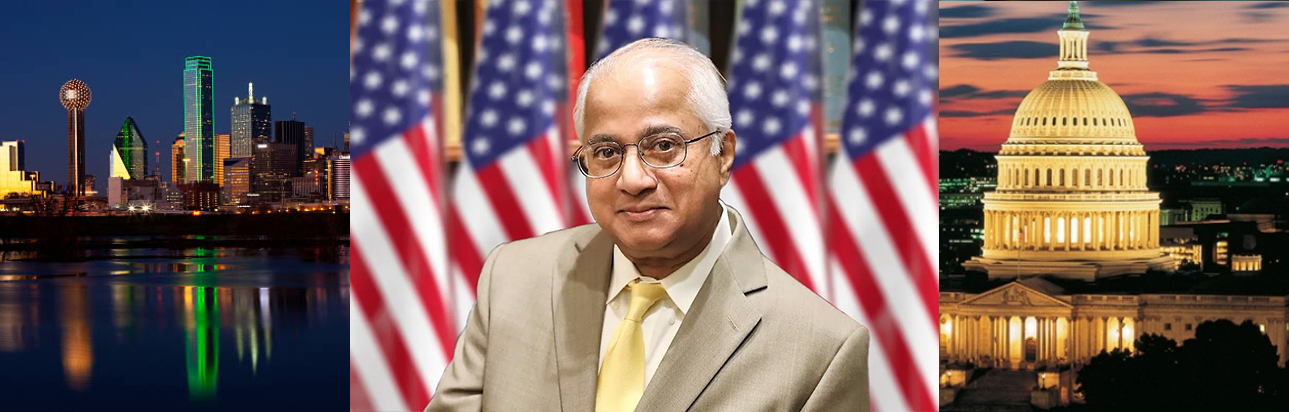
Texas Faith: Is the Religious Right’s considerable influence on politics over?

      Comments Off on Texas Faith: Is the Religious Right’s considerable influence on politics over?

Like most of the right-wing conservatives, Pastor Robert Jeffress lives in a bubble believing in self-aggrandizing information, and aggressively seeking to take advantage of his microphone to get ahead of others in the business of influence. He has done that both in politics and religion and has failed miserably. Continued: http://nabsites.net/demo/texas-faith-is-religious-rights/
 
Texas Faith: Is the Religious Right’s considerable influence on politics over?

The Texas Faith blog is a discussion among formal and informal religious leaders whose faith traditions express a belief in a transcendent power – or the possibility of one. While all readers are invited to participate in this blog, by responding in the comments section, discussion leaders are those whose religion involves belief in a divine higher power or those who may not believe in a transcendent power but leave room for the possibility of one. Within this framework, moderators William McKenzie and Wayne Slater seek to bring a diversity of thinkers onto the Texas Faith panels.

This week’s question has two parts: 1) Should Christian conservatives in the future follow Jeffress’ advice and avoid making prudential issues in which voters can disagree part of their central moral agenda? And 2) even if they do, will it make any difference? Is the era of religious right’s considerable influence on politics a thing of the past?

MIKE GHOUSE, President, Foundation for Pluralism, Dallas

Pastor Jeffress is a politician in the religious garb, not a good politician but the one scanning for opportunities to his advantage, his advice is yet to make sense.

Like most of the right-wing conservatives, he lives in a bubble believing in self-aggrandizing information, and aggressively seeing to take advantage of his microphone to get ahead of others in the business of influence. He has done that both in politics and religion and has failed miserably.

When the evangelicals ganged up on Romney, and unleashed Santorum as the conservative candidate, Jeffress came down on Romney, ruefully representing the Baptist Church and denouncing Romney’s Mormonism. The Moderate Republican majority dumped Santorum and other candidates with sectarian views and opted for Romney, who represented moderation at that time, but when Romney donned on the conservative avatar to clutch the nomination, Jeffress was out again with an embarrassing compromise; supporting Romney.

The moral agenda of the conservatives is to stand firmly against abortion, and same sex marriage, whereas Americans want to live by the First Amendment: government out of religion and their lives. Ironic as it may sound, the conservatives wanted to impose their views on others, and go against the very essence of constitution they purportedly want to uphold. If I were his congregant, I would have advised him to preserve the dignity of church and stay out from falling flat on his face again.

On religious side, Jeffress made a preposterous statement, “Qur’an is a false book written by a false prophet….” to a standing ovation from his congregation. He knew he was wrong and did not take up my challenge, “that if he finds faults with Qur’an, I will convert to his Faith, if not, I asked him to be a blessed peace maker that Jesus had wanted us to be. We held the Quraan conference anyway with 10 non-Muslim religious clergy and honored him for causing the truth to be otherwise. Details at www.QuraanConference.com

The era of religious right’s considerable influence on politics is indeed a thing of the past.

# # #

Published in Dallas Morning News. Message from all contributors at:
http://religionblog.dallasnews.com/2012/12/texas-faith-is-the-religious-rights-considerable-influence-on-politics-over.html/

# # #
Mike Ghouse is a speaker, thinker and a
writer on pluralism, politics, peace, Islam, Israel, India, interfaith, and cohesion at work
place and standing up for
others
as an activist. He is committed to building a Cohesive America and offers
pluralistic solutions on issues of the day at www.TheGhousediary.com. Mike has a
presence on national and local TV, Radio and Print Media. He is a frequent guest
on Sean Hannity
show
on Fox TV, and a commentator on national radio networks, he contributes
weekly to the Texas Faith Column at Dallas Morning News, fortnightly
at Huffington post, and
several other periodicals across the world. His personal site www.MikeGhouse.net indexes everything you
want to know about him.

Ayodhya, the batte for India's soul

      Comments Off on Ayodhya, the batte for India's soul

AYODHYA – THE BATTLE FOR INDIA’S SOUL
URL: http://mikeghouseforindia.blogspot.com/2012/12/ayodhya-battle-for-indias-soul.html

Indeed,
it is the battle for India’s soul. I wrote a commentary on Egypt’s new
constitution, and one of the paragraphs stated, “The Civility of a
nation is measured by how she treats her women, children, the ones in
ditches, the minorities and the voiceless” an Australian professor shot
back and wanted to know India’s record. 

Neither Indian nor American system will score 100 in civility, but
certainly it has the structure to contribute towards that goal, and the rule of law prevails. As a solution, India has offered reservations in jobs, education
system to those economically backward and those in the ditches to uplift them,
we still have Sachar Report’s recommendations to be implemented to uplift Muslims.
We have to pull every one up from the ditches to a point from which
they will be competitive.
Harassment and Oppression of women continues, female infanticide is a
daily occurrence. However, India’s laws are equitable, the
knowledge of which has not permeated into the whole society, but it is
happening. Thanks to the internet and social media, the society will
eventually monitor itself. You can be who you want to be in India. Its a
tough battle, but legally, your path is paved. 

About Shia killings in Pakistan, I wrote, “Like all minorities around the world, the Shia, Ahmadiyya,
Hindu and the Sikh minorities in Pakistan are constantly harassed and
hounded. As I reflect upon it, the issue is much bigger than Shia-Sunni, it is
the majoritarian arrogance that wants to feel superior by pushing the  “others” down and oppress them in everywhich way.   It takes a violent form in Pakistan, but takes
different avatars in different places including our own United States, Israel, India
and other nations. Even though we are a blessed country, we still have bigots
running and saying things that don’t make sense. Thanks to the founding fathers
for making this nation respect the rule of law, which ensures every citizen, a
relative safety. 

Thanks for the founding principles of India that value every human, the law is about equal justice, however we are not there and I hope Egypt will be on a similar trajectory, once their constitution is modified and revised for all people to live freely. 

It does not matter what other nations do, as Indians, India should matter to us. We have
several items of unfinished business, that needs to be resolved where all
parties would walk out with a sense of Mukti from the tension. Things will
simply not go away until there is a national dialogue on these topics: The
exodus of the Pandits, Sikh Massacre, Gujarat Massacre, treatment of Dalits,
female infanticide, reservation system, safety and justice to women, economic
inequity and social justice, and of course Babri
Masjid.

Each
one of us need to shelve our prejudices towards fellow Indians. If you
have it, others have it, if you drop it, others are likely to drop. You
cannot blame others, if you are not free from the blame. A
good society is where no one claims priviliges over others. No Indian
is above the other, nor your opinion is above mine or vice-versa.

I
hope to write the the piece unfinished social business of India before
the end of the year, if someone else writes it, all praise to him or
her.  


Click on the picture to enlarge the maps

I will be writing a full piece on Ayodhya, I did an extensive Radio talk show on Ayodhya on the10th Anniversary and again in 2003. the Dallas Observer had published a lead article on the show then.  If any of you have a good solution, that all parties feel justice is served, write a note to quote in the article. You can do so in the comments section below.

Jai Hind 

Mike Ghouse

Committed to contributing towards cohesive societies

www.MikeGhouse.net   

Courtesy of Wall Street Journal
http://blogs.wsj.com/indiarealtime/2012/12/03/ayodhya-the-battle-for-indias-soul/

Muslims Condemn destruction of Hindu Temple in Pakistan

      Comments Off on Muslims Condemn destruction of Hindu Temple in Pakistan
URL: http://nabsites.net/demo/muslims-condemn-destruction-of-hindu/

We
condemn this disgraceful act of destroying the Hindu Temple in
Pakistan, and request the Government of Pakistan the following actions:

1. Punish the Builder and the miscreants involved in the destruction of the temple. 

2.
The builder to rebuild the Temple or the Government of Pakistan to
rebuild it, as it has restored Krishna Temple in Lahore several years
ago.

3. Request the Government of Pakistan to ensure safety of all of her citizens.

Three years ago, a similar incident took place in Indonesia, where the bad guys burnt a Church, and an appeal was made to
the Muslims around to contribute towards rebuilding the Church,
fortunately the Government of Indonesia took care of it.  I am asking
all in general, but Muslims in particular to be ready to contribute
funds to rebuild the temple. 

Mike Ghouse

World Muslim Congress
Dallas, Texas

………………..


Monday, December 03, 2012
From Print Edition
New 0 0 0

Karachi
When
Laxman saw four men entering the Hindu temple with their shoes on, he
instantly yelled at them to stop in their tracks. But the only reward he
got for trying to protect the sanctity of his place of worship was a
beating. With every punch and kick, he was called names like Bhangi
(sweeper) and Kafir (infidel).

“I can’t explain
how I felt at that moment. I was both enraged and terrified,” said the
35-year-old resident of the Shri Rama Mandir compound in Soldier Bazaar.

The
demolition of the century-old temple stirred a sense of insecurity
among the already frightened Hindu community in the city and reaffirmed
its belief that people practicing the religion existed as second-class
citizens in Pakistan.

“I said they can shoot me if
they like, but I won’t let them go in with shoes,” said Laxman, a man
partially paralysed by a stroke.

“Half of my body does not work, but at that moment, Rama Pir gave me the strength to fight, and I did what I could,” he said.

The
men put the statues and tridents from the temple out on the ground.
Then a bulldozer reduced the pre-partition Mandir to rubble. A number of
houses in the compound were also demolished, rendering around a dozen
families homeless. They even pried opened the donation box and took away
the cash and jewellery, the residents alleged.

“We
have been living in this compound since the British era”, said Maharaj
Badriram, the priest of the Shri Rama Pir Mandir. “We never had any
problems with the larger community, but the treatment meted out on this
occasion was inhumane. People look to me for help, but now, I find
myself helpless,” he said.

A 17-year-old Hindu
boy, who took video footage of the planned demolition, claimed that some
bearded men associated with a political party oversaw the destruction.
“I don’t understand how people can insult the religion of others and
expect respect in return,” he said.

The President
of the Schedule Caste Federation Pakistan, Kalidas Khandara, said that
people in the country take Hindus for granted. “They think we are weak,
so they can intimidate us, but this time, it won’t happen.”

Protest

Hundreds
of people from the Hindu community staged a peaceful rally from Doli
Khata, Soldier Bazaar, to the Karachi Press Club to protest against the
demolition of the Shri Rama Pir Mandir, which was illegally demolished
on Saturday.

“Every time a temple is threatened,
we have to run to the courts. It is the third time it has happened this
year,” said Ramesh Kumar Wakwani, the head of the Pakistan Hindu
Council.

“There should be a stipulated policy for our properties in this country; we are also a part of Pakistan.”

The protestors demanded that the government immediately restore the temple with all its dignity.

Wakwani
said that the double standards against Hindus in the city could be
gauged from the fact that those coming from outside and building shanty
towns in Karachi get leases, but Hindus living here for more than a
century were still considered illegal.

Speaking
about the demolished temple, Kalidas Khandara of the Scheduled Caste
Federation said that Ramapir Mandir was restored by the government in
the year 2000, which went to show that the place of worship was not only
registered, but received government grants as it was adeserving
heritage site.

Sources in the community informed
this scribe that representatives of Hindus were planning to register a
blasphemy case against the real estate builders and government
officials, who flouted court orders and destroyed a religious site.

Demolition condemned

Leading
activist and former federal minister for human rights, Ansar Burney,
strongly condemned the demolition of the Hindu temple in Karachi and
demanded that strict action against be taken against the builders. He
also called on authorities to ensure the safety of the Hindu community,
PPI adds.

Burney said the demolition of the
century-old temple on Saturday by a builder triggered large-scale
protests by human and civil rights activists as well as the Hindu
community.

Burney said the builder not only
demolished the temple, but in a blasphemous act, his workers
disrespected the idols of Hindu deities placed inside the temple.

He
said some people allied with the builder physically hurt some members
of the minority. “Everyone should be free to practice his or her
religion and it is the duty of the government to ensure the safety and
security of minorities living in Pakistan,” Burney stressed.

He
said many Hindu families of Pakistan had already migrated to India due
to persecution and humiliation at the hands of fundamentalists.

“The
builder claims that the land, where the temple is constructed, has been
encroached upon. Even if that is so, the builder should not have
demolished the temple as a humanitarian gesture,” he said. The human
rights activist concluded that he would take up the issue with the local
authorities to ensure that the minority gets justice.

Majlis e Aza, Maulana Hayder Shirazi

      Comments Off on Majlis e Aza, Maulana Hayder Shirazi

URL – http://nabsites.net/demo/majlis-e-aza-maulana-hayder-shirazi/

I attended the Majlis-e Aza, a Shia Muslim gathering at my
friend Aftab’s home, over 50 families attended to listen to the visiting Maulana
Hayder Shirazi in the Majlis (gathering).

The
experience was spiritually enriching and broadening my
horizons of accepting the otherness of others. Indeed, it is time for us
to get
to know each other, we don’t have to agree or disagree with our madhabs
(denominations) and rituals, but we can develop the capability to
respect each
other and find solutions to live in harmony. We need to include in our
teaching, that disrespecting Allah’s creation, fellow humans, amounts to
disrespecting God. Indeed, God says in Quran, killing one person
amounts to killing the whole humanity, and saving one life is like
saving the whole humanity.


Two teenagers sang the Marsiya (melancholic songs) followed
by a chorus, “Mere Abbas Jahan ho” it was powerful and moving.  Abbas was the 32 year old brother of Imam Husain (as). He was Imam Husain (as)
and Islam’s flag bearer. He is known for his utmost loyalty to Imam Husain. He
was brutally martyred by Yazid’s (self proclaimed, evil king) army when he went
to fetch water for the very young children within Imam Husain’s family who
had been thirsty for more than 3 days.

Ali Asghar  was a six
month old son of Imam
Hussain, who was prevented from getting water from the river for his
sick child,
while he was waiting and holding Asghar in his arms, Yazid’s men (evil
king)
shot an arrow at the baby and martyred him. This sad story is a reminder
of what the evil is capable of doing, and the need for us, each one of
us, to speak out against evil things happening in our daily lives.

The program began by praying for a Shia girl killed in Pakistan. I felt the
surge of blood in my veins, what is happening to Pakistan?   During this Muharram (first month of Islamic
Calendar and the Martyrdom of Imam Hussain on the 10th) an endless
number of Shia Muslims were killed,  a
few weeks ago a bus was stopped and all the people were asked to get out, and
they killed each one of the 19 Shia in the bus, sparing the Sunni. This is
simply not acceptable. Until we feel the suffering, and until we stand up for the rights of others be it
Muslim or not, the humanness in us gets depleted. These Murderers are disrespectful to God.

Like all minorities around the world, the Shia, Ahmadiyya,
Hindus and the Sikhs minorities in Pakistan are constantly harassed and
hounded. As I reflect upon it, the issue is much bigger than Shia-Sunni, it is
the majoritarian arrogance that wants to oppress the minorities.  It takes violent form in Pakistan, but takes
different avatars in different places including our own United States, Israel
and other nations. Even though we are a blessed country, we still have bigots
running and saying things that don’t make sense. Thanks to the founding fathers
for making this nation respect the rule of law, which ensures every citizen, a
relative safety. 
The civility of a nation hinges on how it treats its weak,
its women, its minorities and the ones in the ditches.  
While sitting in this particular Majlis, for a few brief
moments, I asked myself, are we not all Muslims? We eat the same food, we look
the same and we speak the same language, and most of us espouse the same faith.
What causes the hatred and ill will that is going on in Pakistan? Why do we exclude
others in our conversations?

Of course, the Maulana addressed the Shia more than once; after all it was a
Shia gathering. The same thing happens at the Sunni, Bohra, Ismaili or
Ahmadiyya gatherings; their talk does not include other Muslims at all.   


 Yet, I have heard the all-inclusive-prayer,
even today, as in every Mosque I have been to, “Allahum maghfirli wali walidaiyya wali ustadhi wali
jam’il mu’minina, wal mu’minat wal muslimina wal muslimat –
Dear God! Forgive me and my parents, and my teachers, and all the believers,
the Muslim men and women.” Do we mean it or we just recite it to get it over?    You
cannot seek peace for just one, and not the other, as our peace hinges on peace
to others. 

 Well, that is the
case with every place of worship I have been, whether it is Christianity,
Judaism, Hinduism or Buddhism.  That is
contrary to the teachings of all religions, each one of them ….taught to get
along and respect the other.  We have to
learn to know each other, the more we know the other, the less conflicts we
would have (Quraan 49:13).


Maulana Hayder Shirazi has that calmness on his face that
generates tremendous respect for him, a humble man, as most of the Imams I have
known in Dallas.  He is visiting from
London and studied in Qom, Iran for 14 years! I was glad to hear that they also
teach about other denominations of Islam, as an optional subject.  The teachers are Shia who teach the Sunni
version of Islam, I am sure it will be honest, as I have known the Sunni Imams
who respectfully talk the Shia version, as Shia understand it.
Maulana talked about loyalty and obedience to the
principles, and elaborated Ateeullaha o
Ateeur rasool
very well. If you are not loyal to your wife, and vice-versa,
more than likely you will not be loyal to the creator, if you don’t listen to
parents, more than likely…. I was watching the youth listening to him
attentively. He communicates well with his message.
He also talked about Tasweef; that is procrastination. He
shared the story of two brothers from Baghdad who went to India, and one of
them could not go to Hajj while the other did. The point he was making was, if
you postpone Hajj, you can justify it to perform next year, or when you get
older, or if it is about repenting, we cannot wait till the last breath, as we
may not get the chance to repent it. His advice; do it now.
He was talking about the Ghayab Imam, or the Imam who would
appear one day, and he will, if we do our part, be righteous. 
The Haram and Halal conflicts ends with life on the earth,
he said one would be free from such conflicts in heaven. God can do anything kun fa ekoon, he just thinks and it
happens. 
He was telling the story of Karbala  and when he narrated the part, where Yazid
wanted Zainab be killed and brought to him in disgrace. Thanks to Munawar-Ali Abbas for sharing the following, “Zainab was the sister of Imam Husain (as). She accompanied Imam Husain (as) to
Karbala. After the brutal Martyrdom of Imam Husain (as) by the army of “evil
king,” Yazeed (la), the women and children of Imam Husain (as) were made captive
by the army of Yazeed (la). They were all taken in great disgrace and were
tortured from Karbala to Kufa, and from Kufa to Syrai (Shaam).”

She would not
compromise her principles but willing to die for it instead. The adults started
crying out loud, and for a few minutes, I was the only one who did not. As the
story progressed, listening to the humiliation of Zainab endured against Yazid’s
unabashed harassment, I could not hold myself from crying. I just could not
believe I did that. It felt good to intensely feel the suffering, humility and
pain. You always salute those who stand up for the righteous principles.

At the end of the program, everyone got up and followed the
unique Shia ritual, of beating the chests with both hands; it was loud and in
unison and went on for about 15 minutes. The chanting was “kat gaye aale
Muhammad ke gharanay walay” – martyred are the prophet’s family members. 
Everyone was deeply involved in the chanting and the chest
beating, and momentarily I felt odd…and out of place, but was admiring the
bonding it was facilitating. There was a temptation not to be an odd ball and
do what others were doing… but I was severely fighting within myself, then I
chose not to, as it would be something other Sunni or other Muslims cannot
replicate, but we need to know each other. 
My comfort increased when I invoked Pluralism ideals in me that we all
have to learn to respect the otherness of others, and we do not have to agree
with each other, but be respectful of each other. Indeed, that model was
provided by Prophet Muhammad (pbuh) as expressed in the link – http://www.youtube.com/watch?v=AsbuwRSnvNY
And that is what knowing each other means in Sura 49:13 is
expressed in the following video. https://www.youtube.com/watch?v=TCDwxcz65XY
The food was good, it was lentil-meat with Naan and Halwa!

Insha Allah, I will be writing the essence of Hanukkah,
Christmas and other festivals in December, so we can now about each other. Please
make an effort to participate in Shia, Sunni, Bohra, Ahamdiyya, Ismaili, Deen
Mohammad and other Muslim events. To be a Muslim is to be a peace maker, to
mitigate conflicts and nurture goodwill.

———-
Mike Ghouse is a speaker, thinker and a
writer on pluralism, politics, peace, Islam, Israel, India, interfaith, and cohesion at work
place and standing up for
others
as an activist. He is committed to building a Cohesive America and offers
pluralistic solutions on issues of the day at www.TheGhousediary.com. Mike has a
presence on national and local TV, Radio and Print Media. He is a frequent guest
on Sean Hannity
show
on Fox TV, and a commentator on national radio networks, he contributes
weekly to the Texas Faith Column at Dallas Morning News, fortnightly
at Huffington post, and
several other periodicals across the world. His personal site www.MikeGhouse.net indexes everything you
want to know about him.

Building Bridges on Turkish TV with Mike Ghouse

      Comments Off on Building Bridges on Turkish TV with Mike Ghouse

BUILDING BRIDGES – MIKE GHOUSE ON TURKISH TV-A9

God wants us to live in peace, and harmony with each other.  If we follow the Sunnah (practice) of Prophet Muhammad and follow the Guidance of Quraan, we can seldom go wrong.   What does it take to build
that momentum… to bring about a change in a society,   I am glad
to see Muslims taking the initiatives to build a cohesive world. The Role of Muslims in building cohesive societies was broadly the topic, and Pluralism,
co-existence, Islam, Israel and peace were part of the conversation.  Continued http://nabsites.net/demo/building-bridges-on-turkish-tv-wi/

VIDEO http://www.harunyahya.com/en/works/154210/

 
Thanks to the Turkish
Television A9 for their program building bridges with guests from around the
world. If you get the time, check out some of the fascinating interviews.
I was called to talk
about Role of Muslim in the world, and Pluralism, co-existence, Islam, Israel
and peace. What can we do to bring about
a change in a society, what does it take… I am glad to see Muslims taking the
initiatives to build a cohesive world.
On my part, I have a
lot more work to do, one of them is to get Jews, Christians and Muslim to start
including Hinduism, Jainism, Buddhism, Sikhism, Baha’i, Wicca, Earth based and
native traditions as a part of their casual conversation.
My message at the end
was, God has intentionally created us to different races, religions,
ethnicities and cultures, let’s honor gods wish for us to live cohesively.
God willing and media
willing, I will be on a few more TV talk shows in 2013, but my dream is to be
on Jon Stewart and Rachel Maddow Shows, I will make the effort to communicate
pluralism with humor.


Thank you.
Mike Ghouse is a speaker, thinker and
a writer
on pluralism, politics, peace making,
foreign policy, Islam, Israel, India, Pakistan, interfaith, and cohesion at
work place or social settings. He is committed to building a Cohesive America and
offers pluralistic solutions on issues of the day at www.TheGhousediary.com.
Mike has a strong presence on national local TV, Radio and Print Media, and is
a frequent guest on Sean Hannity show on
Fox TV, and a commentator on national radio networks, he contributes weekly to
the Texas Faith Column at Dallas Morning
News
, fortnightly at Huffington post, and
several other periodicals across the world. His personal site www.MikeGhouse.net
indexes everything you want to know about him.

United Methodist Church Panel on Politics and Religion

      Comments Off on United Methodist Church Panel on Politics and Religion
UMC PANEL
Politics and Religion:
A Discussion on the Role Religion Played in the Recent Presidential Election
November 29, 2012 12:00-1:30 PM
Panelists: Sam Hodges, Jeff Weiss, Derek Jeter and Mike Ghouse
URL: http://us5.campaign-archive2.com/?u=f39de1c5273648e9a4297c0e1&id=a99ed23aa9&e=5ea40fdbce
….
Note: due to time limitations; I am pleased to record just a few random notes from event, If I get the
time, I will elaborate on each panelists take. 
A few highlights:
Jeff Weiss shared how the
candidates Santorum, Bachman and Gingrich had defined themselves in sectarian terms,
while Sam Hodges shared the movement of the society towards secularization, and
Derek talked about the bubble Republicans lived in. My take was the trend
towards pluralism, and that this election has firmly established the separation
of church and state. 
Jeter spoke about the position of
the evangelicals and we all discussed about the fears and phobias of each
group, the fear of evangelicals to see the world move towards sinful societies,
a violation of God’s covenant. He and I carried the discussion further about
how the conservatives in Islam, Christianity, Judaism, Hinduism and others want
to hang on the covenant. I can see the safety and clarity of that position. He
was open to seeing it from a pluralistic point of view as well, meaning the
same scripture is viewed differently by the liberals. 
It was a great honor for me to
sit between Jeff and Sam, both of whom I have come to admire for years. Jeff
was a recipient of the Pluralist Award for his equal opportunity criticism of
faiths while Sam is also a recipient of the award in 2011 for this drive to
present another point of view. The awards are bestowed at the annual Unity Day
event. www.UnitydayUSA.com
 
My talking points (not sequences
or written in sentence format) written earlier, but not shared as written, most
of the conversation was in response to each other’s comments.

We think you should plan to have a short
opening statement about who you are (2-3 minutes only please   and then be ready to answer questions from
the group.


I was born and raised
in India and chose to be an American some two decades ago. The most attractive
thing about America is freedom, the personal, social, business, religious and
cultural freedom. It’s near absolute freedom except where the public safety is
concerned. Freedom is the most cherished value for me, it means questioning
everything, including my own belief, and why I do or don’t do things.
I was raised in a
Muslim family like millions of other Muslims, and when I was a teen, I chose to
be ir-religious, however, there was not a religious place I did not visit or
participate, and people’s faith amazes me. I remained an Atheist for nearly
thirty years and about 15 years ago I chose Islam to be my religion, let me be
clear, it could have been any religion, all of them provided the same value; to
find peace within and peace with what surrounds.

 I have made some outrageous statements
to the orthodox folks – that my religion is not superior or inferior to any. If
it is superior, it amounts to arrogance and arrogance is the mother of all evil
and conflicts. Religion is about humility.

My mission is
pluralism – that learning to respect the otherness of others and accept the God
given or genetic uniqueness of each one of us, if we do that, then conflicts
fade and solutions emerge.

Much of my work is linked to some 5 sites, and 30 blogs on each topic at www.MikeGhouse.net 
Thanks to Dallas Morning News, Huff post, Washington post, Hannity and
sanity… for giving me the opportunity to express my thoughts.

I am committed to building cohesive societies, where no one has to live in
apprehension, discomfort or fear of the other. My book will be out by Christmas
and movie will be done next Christmas.
  

Where do we draw that fine line between
church and state in the election process….for instance, if a church paid for
billboards with political messages, or endorsing a specific candidate, should
they lose their non-profit status?

Church is about faith, governance is about living with each other
First amendment
Non profits political orgs.. Where you don’t even disclose the giver
Are we assuming all members of the church vote the same way?
Why should a pastor coerce an individual to hide his political identity to
majority?
Big donors to sway? Isn’t that a loss of freedom and democracy?


Where’s the freedom?
Shouldn’t that be an individual decision!


The purpose of
nonprofit status was to give a break to smaller churches so they can attract
donations… I kind of liken it to the Sherman anti-trust act which It
prohibits certain business activities that reduce competition in the
marketplace

How does the rise in social media change
the dynamics of religion and politics? How should churches react to political
messages posted on their Facebook pages by church members?

Social media had taken over religion…
Posting should be with disclosure… That it was a pr firm, no way to monitor…
I have personally crossed my own lines a few times… I was the only one, at
times, and felt it was unfair to Romney…even though I was not voting for
him..

How successful were religious groups
during this election cycle (nationally and/or locally) …. are there any
measurable statistics?

Very successful, all were driven by fear
-83% Jews, 95 Muslims, African 96, Latino 73%

The glbt was not an issue at all… The ones opposing are ones giving votes
There is a Trend towards pluralism… Separation of church and state in
practice

What can we (as church communicators) do
in the next four years to prepare for 2016? Will religion be more of an issue
or less?

Keep state out of church
Same sex marriage, contraceptives, Sharia, question the politicians if they
know the stuff to oppose or support an issue


Religion will not be an issue in 2016, the ones who bring, stand to lose, 2010
was an Anomaly…
———– ­­­­­­­­­­­­­—————–
We have a great panel that will
discuss the role religion played in this latest political cycle.
How did the various groups use
religion as a positive marketing piece for a candidate? Or was it used as a
negative weapon against a candidate? Did religion really play a role or was it
just used to deflect attention?
Bring your questions about
politics and religion and challenge our panel of experts in this arena!

Event Details
When: Thursday, November 29
Time: 12 noon to 1:30 p.m.
Where: Christ United Methodist
Church, 2801 Valwood Parkway, Farmers Branch
Cost: $15 and includes lunch.
RSVP: Email or call Deb
Christian, dchristian@umr.org,  214.630.6495 
x147

About our Panel:
 Mike Ghouse is a speaker,
thinker, writer, initiator, organizer and mediator committed to building
cohesive societies, and offering pluralistic solutions on current issues. Mike
is a frequent guest on Fox News, “The Hannity Show”, and on nationally syndicated
Radio shows including Dallas TV, print and radio networks, and occasional
interviews on NPR. Mike is a member of the Texas Faith Panel at The Dallas
Morning News and writes about issues facing the nation every week. He writes
for The Huffington Post regularly, and occasionally for Washington Post and
other daily newspapers and magazines around the world. Mike has published over
1000 articles on a variety of subjects.
Derrick Jeter has dedicated his
professional life to challenging honest skeptics and seekers to wrestle with
the most pressing questions regarding the life of faith and the preservation of
liberty. After his undergraduate work at UT and receiving a master’s degree
from Dallas Theological Seminary, Derrick began a public speaking consultancy, working
with business professionals and politicians. Derrick is also the author of two
books published by The Jeter Press: A 911 for 9/11: Finding Answers to the Evil
of September 11, 2001 and O America! A Manifesto on Liberty.
Sam Hodges, a managing editor at
the United Methodist Reporter, has had a long career in newspapers, including
reporting on religion for the Dallas Morning News. While at the Mobile (Ala.)
Press-Register, he won a George Polk Award for a series on scarcity of dental
care for poor children. He has won several other awards, and was a journalism
fellow at the University of Michigan. He’s the author of a published novel and
co-editor of a published book of his great-great-grandfather’s Civil War
letters.
Jeffrey Weiss is a weekly
columnist for Real Clear Religion, and a longtime reporter and blogger for The
Dallas Morning News. He was previously general assignment reporter, and social
services reporter for The Dallas Morning News, and a regular contributor to the
late Politics Daily. He has also reported for The Miami Herald. Weiss was
awarded second place in the Templeton Religion Reporter of the Year award, and
Schachern Award for Best Religion Section by The Religion Newswriters
Association, as well as a contributor to the piece that won the Wilbur Award
for Best Religion Section by The Religion Communicators Council, in addition to
many other nominations and honorable mentions.
We are extremely thankful to
Christ UM
C in Farmers Branch for being
such a gracious host to our organization, but we would love the opportunity to
visit other organizations throughout the DFW area. If your organization would
be interested in hosting RCC for a luncheon in 2013, please contact Andra Dunn
at programs@dfw-rcc.org for more
details.
Our goal for the upcoming year is
to grow our organization and inspire religious communicators in the metroplex
in their ministry of telling the story of their organization, engaging their
audience, and shining their light even brighter in a world that is hungry for
positive and uplifting messages.
——————
Mike Ghouse
www.MikeGhouse.net