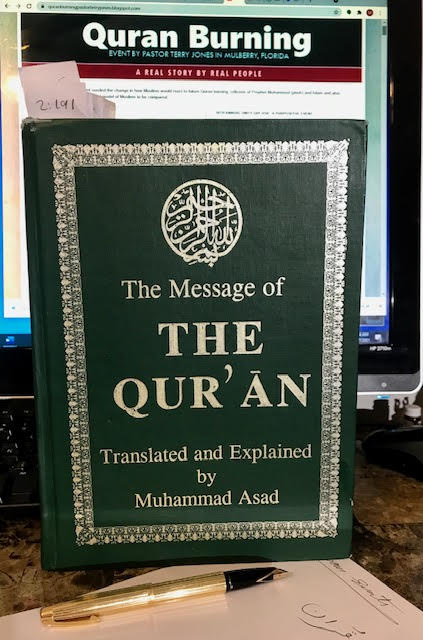
courtesy Steve Blow of dallasnews.com/ – Link : https://www.dallasnews.com/news/faith/2010/09/14/texas-faith-what-religion-stories-should-the-media-focus-on/
By Bill McKenzie
I’m pleased to announce the participation of two new panelists: Dr. James Denison and interfaith proponent and blogger Mike Ghouse. They will join our team as we move into our third year. Over the next few weeks, we will add a few more panelists, but today I want to welcome Jim and Mike.
Jim long served as pastor at Park Cities Baptist Church in Dallas. He now is president of the Center for Informed Faith and is a distinguished adjunct professor of religion at Dallas Baptist University. He also is a theologian in residence for Texas Baptists.
Mike presides over the Foundation for Pluralism, is active in the World Muslim Congress and blogs regularly at various sites. He also has been a city commissioner in Carrollton, Texas and serves on the board of the Dallas Peace Center.
You can read more about them on our website later this week. Meanwhile, I know Wayne Slater, Sam Hodges and I look forward to their participation.
Now, onto this week’s question:
There has plenty of criticism of the media for the amount of attention paid to Terry Jones, the pastor of the 50-member Florida church who had been planning a Quran-burning until he was talked out of it. Colin Powell typified the questioning of the media when he wondered on ABC’s “The View” last week how a guy like Pastor Jones could end up commanding so much attention from the press.
That’s a fair question, so let’s turn the tables this week, which comes a few days after the anniversary of 9/11. Here’s the question for discussion;
If you were a media baron, an editor or a television or radio producer, what religiously-based stories would you focus on?
Read on for numerous responses, many of which conclude that”sensationalism sells.”more
KATIE SHERROD,Writer, film producer and progressive Episcopalian activist, Fort Worth
One of the definitions of news is information that is unexpected, unusual and seemingly out of character. Hence, the cliche about “man bites dog” making news when a dog biting a man would not. Because most religions claim to be about love, it makes news when a religious leader starts preaching hate.
The key word here is “leader.” One could argue that a pastor of dubious background with a flock of 50 hardly merits that description.
The New York Times has published a thoughtful look at the development of this story. It discusses the role the story of the Islamic Center near Ground Zero, coupled with the 9/11 anniversary and reactions of Muslims overseas, played in decisions about covering the Gainesville pastor. It also details the lengths the more responsible news outlets went to avoid giving the pastor undue attention, and thus, undue influence.
A key sentence in the article is a remark by Bill Keller, the executive editor of The Times. He said “that the newspaper had ‘no policy against publishing things that might offend someone — lots of people are offended by lots of things — but we try to refrain from giving widespread offense unless there is some offsetting journalistic purpose. A picture of a burning book contributes nothing substantial to a story about book-burning, so the offense seems entirely gratuitous. The freedom to publish includes the freedom not to publish.'” [Emphasis added]
Having been an editor who made decisions about which stories to cover, I find the question an interesting one. I can remember when the question would have been “Why cover religion at all?”
For the most part, newsrooms did not cover religion in any meaningful way. For decades, George Cornell of the Associated Press was just about the ONLY “religion reporter.”
Then in 1986, the San Jose Mercury News pioneered a religion section called “Religion & Ethics.” In 1992, ABC News anchor Peter Jennings hired Peggy Wehmeyer away from WFAA-TV, making her the only full-time network religion correspondent.
About that same time, the Dallas News began a whole “Religion” section. Religion coverage was defined as including ethics, morality and “spirituality.” The News’ section was called “Religion,” with “spirituality and values” in smaller type above the section name. Since then, religion coverage has been an integral part of routine news coverage for all general news outlets.
But religion stories are no different from sports stories or political stories. Decisions about which religion stories to cover should be made on the same basis as all other stories:
— Is it of wide interest? Is there conflict, novelty, or a prominent person involved?– Is it based on solid sources?– Is it timely?– Is it relevant to your community, city, state?– Is it put in context?– Does it offer anything new — a new angle to a discussion, a new interpretation? Does it change the status quo in any significant way? Is it “a first”, “a last”, “an only”, or an extraordinary event?– Do your readers need or want to know the information?Religion is like art and politics — it touches people “where they live” and thus can elicit strong reactions. That makes it even more imperative that the same standards be applied to it as to all other news stories.
DEAL HUDSON, President, Morley Publishing Group and Director, InsideCatholic.com
Colin Powell’s comment on “The View” that the threat of Pastor Kevin Jones to burn the Koran should not have attracted so much media attention is not the opinion of a journalist but of a member the D.C. elite who thinks the media should avoid stories he finds personally distasteful.Journalists cover stories that are new, unique, and culturally significant, whether or not the reporter, or the editor, agrees or disagrees with their point of view. Terry Jones, wacky or not, is one of those stories. There’s been entirely too much of an elite attitude displayed in the media, where visibility is being given to what comports with the political viewpoint of the reporter and/or publication, rather than a concentration on what is newsworthy.
JAMES DENISON, President, Center for an Informed Faith, Dallas
During World War II, as our government worried about enemy spies in our midst, Americans were cautioned that “loose lips sink ships.” The admonition nearly came true last week, as Gen. Petraeus warned that our troops would be endangered if Terry Jones persisted in his plan to burn the Qur’an.But what if there had been no media coverage of this threat?Sensationalism sells. Religiously-based stories possess a heightened ability to enflame passions and encourage extremism. What guidelines might help ensure responsible coverage of such stories in these conflicted times?First, does the story serve the common good? Americans need to know that Yemen is a new front in our battle against al-Qaeda; do we need to know that the pastor of a 50-member congregation wants to burn the Qur’an? Absent such publicity, would his plan have threatened our troops?Second, does it encourage understanding or misunderstanding of the faith tradition in question? Coverage of Terry Jones’ threats did little to contrast his actions with biblical teaching such as John’s exhortation, “Dear friends, let us love one another, for love comes from God” (1 John 4:7, NIV). Paul did not burn the idols he found in Athens–he used them as a bridge to the Christian message (Acts 17:22-23). Media coverage should have disclosed the aberrant nature of Jones’ theology and behavior.The Bible teaches us to “speak the truth in love” (Ephesians 4:15 NLT), considering the consequences of our words before we utter them. We cannot unring a bell.Marshall McLuhan claimed that “all media exist to invest our lives with artificial perceptions and arbitrary values.”
RIC DEXTER, Men’s Division Chapter Leader, Nichiren Buddhist Soka Gakkai lay organization
Not that long ago the Dallas Morning News had a religion section. I remember reading in it stories of people who practiced different faiths, and people who practiced their faiths differently. There I found articles covering news relating to difficulties facing different churches or their leaders. I read discussions about abuses in some of them, and about the social and spiritual triumphs of others. When I read the question this week I thought, “There is a place to start.”This forum was born out of that now sadly discontinued section. Many media outlets currently seem to feel that the only “religion” stories worth reporting are those that highlight controversy, those that sensationalize, and those that will sell more paper or airtime. One must ask, is this really a reflection of the values we hold most dear in our society?I would rather publish stories about the strength people find in their belief system, and about how people have put the wisdom of these teachings into practice in their daily lives. I would publish articles which would inform beliefs, and demonstrate that “If Christ, Abraham, Mohammad and the Buddha were to sit at the same table, they would find much more upon which they agreed than upon which they disagree.”I would also publish the dissenting voices, so the readers could be informed about those areas where there is disagreement. We are not, after all, “just different paths to the same end.” An awareness of our different world views would allow us to appreciate that we need not all agree in order to live harmoniously in this world we share.I would focus on the elements in our lives that create true value.
MIKE GHOUSE, President, Foundation for Pluralism, Dallas
“The business of the journalist is to destroy the truth; to lie outright; to pervert; to vilify; to fawn at the feet of mammon, and to sell the country for his daily bread.”
Ever since John Swinton, of the New York Times uttered those words in the last century, discussions among media barons have continued about the nature of their business.
Every aspect of a society continues to seek its own equilibrium; the once abusive capitalism is on the course of self-correction and blissfully moving towards responsible investments.From a journalism point of view, unconscionably, we have accepted the inclusion of sensationalists and propagandists as journalists. They are generating ratings and revenues for the media barons. I believe this aspect of destructive propaganda journalism will also start correcting itself toward responsible journalism, which can restore the social cohesion of our society. This week’s topic for the Texas Faith panel is an indication of such a movement.The media in Dallas has acted responsibly this week, when Pastor Jeffress made incendiary remarks about Islam, whether one agrees or not. Steve Blow of the Dallas Morning News took on the responsibility to seek another opinion from some one like Pastor Bob Roberts. Blow offered an equally powerful, but peace making perspective, which the public has welcomed.Whether it is Pastor Jones, Jeffress, Phelps or Robertson, the media has failed to nail down the exact words or phrases that cause them to make such divisive declarations, and the unfinished business is frustrating the public. The real issue is not the amount of coverage but the quality of coverage.As a media baron, I would consider leading the torch of responsible journalism by addressing the moderate majority. It is untapped, but the biggest niche in the marketplace. Moderates are crying out loud for the media to be fair, just and responsible. On the other hand, they need to reward the change and move away from the idea of “No news is good news” and instead, read and watch the good news and not discount it as “no news.”
CYNTHIA RIGBY, W.C. Brown Professor of Theology, Austin Presbyterian Theological Seminary
Here’s my explicit answer to the question: how about putting some legs under the story of a small church Minnesota pastor (Gordon Stewart) who had a Muslim read from the Qu’ran in worship this past Sunday?
I know about this because I am currently in Minneapolis, teaching and preaching at the Presbytery of the Twin Cities. From what I can gather, Stewart’s vision and approach have contributed a great deal to the healing of anxieties and the restoration of hope.
Here’s what else I want to say about the issue raised in the set up to the question:
No disrespect to Colin Powell, but it seems to me to be too easy to blame the press for our (the public’s) obsession with certain media stories. While it is true that the press teases out public interest by bringing stories to our attention, the relationship between the amount of coverage and the amount of public interest winds up being more of a chicken-and-egg kind of phenomenon.It seems to me, along these lines, that the press gave the Qu’ran-burning story a lot of attention because people kept wanting to hear more. Part of the reason many Americans followed the story so closely, I think, is because of all the hard-to-manage opinions and emotions surrounding the debate about the near-to-Ground-Zero cultural center.Maybe the demand for heavy coverage of this story served some kind of psychological function for us, culturally speaking: perhaps we felt afraid and/or angry enough, near the anniversary of 9/11, to find some twisted gratification in imagining something most of us would (hopefully) never do: burn Qu’rans. And maybe – just maybe – witnessing the hateful actions of Terry Jones led us on some level to say to ourselves: “I do not want to be like that.” I wonder if the heavy coverage might actually have done some good by offering a “negative example” – perhaps it has highlighted just how ugly prejudice can be in ways that will goad us to repentance and transformation.So: I think the media should report precisely on stories such as the threatened Qu’ran burning, and also on the “positive” stories I see them reporting on all the time.Consider the range of stories on the Dallas Morning News religion blog alone, over the past two weeks: Stanley Hauerwas’ memoir, Brian Wilson and Dallas’ “Day of Praise,” Women in Christian Media in New York; the impact of religious faith on community outreach; what it means, spiritually-speaking, to grow old.And maybe Pastor Gordon Stewart and the witness of his congregation can be added to the list.
M. BASHEER AHMED, Chairman, Muslim Community Center for Human Services, Dallas
Media only pay attention to sensational stories to sell the product. Decent, non-sensational stories seldom get attention of media or they are printed in small letters on the back pages.
To develop a civilized society, I would give equal importance to religious stories that promote tolerance, peace and harmony in the community.
There are two ways to broadcast a message. For example, I heard on the radio that ” 49% of people oppose mosque on Ground Zero.” Couldn’t that same news be reported: “50% of people support mosque on Ground Zero?”
If only Pastor Terry Jones, the firebrand behind the “International Burn a Koran Day,” had been going to Graceland. A small detour could have led him to the doorstep of fellow Pastor Steve Stone.
When Stone read in the newspaper that a new Memphis Islamic Center was coming to town, he scrambled to make a sign and took to the street. It read “Heartsong Church welcomes Memphis Islamic Center to the neighborhood.”
This sign hasn’t received much attention since it went up a year and a half ago.
GEOFFREY DENNIS, Rabbi, Congregation Kol Ami in Flower Mound; faculty member, University of North Texas Jewish Studies Program
So I’m a “media baron?”
I understand the news is mostly about the negative and the novel. The sensational sells, and sometimes it deserves the attention it gets.One sensational religion story I would like to give more constant media attention is the persistence of brutal judicial punishments meted out by religious courts, such as stonings and amputations.I would also like to focus on more in-depth investigative stories examining the role that modern religious law has played (for good or ill) in other of the controversial criminal stories we are aware of, such as the priest abuse scandal, wife abuse, and honor killings. These issues are international in their reach and affect thousands. There is something to be reported on about what religious laws sanction, condemn, and shield in every religious tradition. It is also clear that some people of faith feel their loyalty is divided between state law and their tradition’s religious law. We need to better understand this issue and how it may influence law and policy in the future.Another story I’d like to give attention is the proliferation of interfaith programs, institutes, and think tanks, which are growing across the United States and in Europe. Pollsters tell us the reach and influence of religion is diminishing, yet we seem to see more issues of religion appear in political and policy stories. I’d like to better understand why.I would produce more stories highlighting persecutions inspired by religious beliefs, like the Christian inspired law in Uganda that would make homosexuality a capital offense. In Iran, seven Baha’is have been sentenced to long terms of imprisonment based on their minority faith. This is only the latest in a long history of such persecution of the Baha’is, but most people are oblivious to this history.There is also the fact that Christian minorities are under siege in several countries. Whether driven by the state or by cultural intolerance, the public needs to be made more aware of these persecutions.
LARRY BETHUNE, Senior Pastor, University Baptist Church, Austin
Blaming the messenger is an old strategy for dealing with news we don’t like. In a democracy that depends on the free flow of information, I am hesitant to limit journalists on what stories they should and shouldn’t cover. Any and all religious stories are worthy of coverage by the press. Freedom of the press goes hand in hand with religious freedom.
On the other hand, journalists should be called to ethical standards not only in the way they report the news, but in the news they choose to report (or not report). While the extreme bias of Fox News has made the phrase “fair and balanced” an ironic punch line, fair and balanced reporting of religious news should keep the source in perspective and report alternative views.
While much of the initial coverage of the Florida Qur’an burning threat included the small size of the pastor Jones’ church and the opposing Christian voices, this balance was mostly lost as 9/11 drew near. I am glad Pastor Jones changed his mind, but I fear the damage was already done in the international reporting of the threat.
To answer the broader question, a more thorough reporting of the positive stories emanating from religious communities of all kinds would set a better context for the negative stories. The kind of stories the public loves on television programs like “Extreme Makeover” happens frequently in religious communities who care for their own people or reach out to strangers in need. Perhaps the recent negative religion stories in Florida and New York would be heard differently if the nations – and the world – heard more stories about the kindness and care offered by Christian and Muslim communities to people beyond their own communities or religious adherents.
Good news is still news and needs to be reported as the context for showing when bad news is extreme and contrary to the main stream.
DANIEL KANTER, Senior minister, First Unitarian Church of Dallas
My hope for the media is that it succeeds despite its tendency to report religiously-based stories on hatred, conflict, and violence. If the media can wean itself from that type of reporting, I would hope it could stimulate interest in motivating people to pay attention to good works done in the name of religion, dialogue, and those acts which bind us together as one human family.
American society needs help in breaking down many barriers that paint religion as the problem. It needs help with stories on how the religious vs. the non-religious work together, on seeing faith as more than belief in a God protected by the few, and on embracing a wide spectrum of spiritual responses to the human condition.
American society could use some help in seeing our commonalities through the lens of faith rather than continued stoking of the fire of difference. In the name of all the foundations of our religions, we have a guiding human purpose to engender love and service in all we do, and we need help realizing this.
DARRELL BOCK, Research Professor of New Testament Studies, Dallas Theological Seminary
The media needs to focus on a whole variety of religious stories. Collaborative stories of groups working together and how religious groups fill gaps in our social net are especially valuable. A lot of religious coverage is negative or about the negative things religion does (and those should continue to be covered because the accountability to society is also important).
Stories that help mutual understanding about the different faiths also are something media can do (Here dealing with the way stereotypes may misrepresent can be important). How religion influences decision-making on certain issues is also another angle on things.
So there is much that can be done here. It’s important that people covering these topics have some background for it. Getting good background help for these stories also is important.
AMY MARTIN, Executive Director, Earth Rhythms; writer/editor, Moonlady Media
“Ka thunk… ka thunk… ka thunk.” It’s the now familiar sound of Walter Cronkite spinning in his grave.Yet this particular case did have a positive side effect by inspiring much good dialogue on religious tolerance. While extremists like Terry Jones were loud, over and over again in quiet conversation I heard people say that extremists of any kind of group – religion, politics, the ladies sewing circle – do not represent its majority.Even more than a morality tale against the damage that careless generalizations can create, the whole affair set off ripples overseas. If the Muslim world was watching a religious wacko threatening to burn their holy book, they also saw many more Americans vigorously protesting against such an act.People are fascinated by fascinating things. With his outsized mustache and crazy mannerisms, Jones was a natural for the camera. But characters abound in our society. They capture some aspect of a topical story, while being far less inflammatory.News should be human, covering all of the human experience, not just transitory conflicts but the issues that are threaded deeply through our lives, like the nature of religion and the meaning of existence, the tangle of human behavior and emotions, the quiet panic of raising children and the joy of life’s quiet pleasures. “Human interest stories,” my old buddies in the newspaper business would sneer.Yet human interest doesn’t have to mean sappy or non newsworthy. The shows “This American Life,” “Speaking of Faith” and “The Story” from public radio programming providers – programs that cover topical news as well as the conditions that underlie it – show how edgy, deep and fascinating human interest can be. These are the type of shows I’d like to see and hear more.
JOE CLIFFORD, Pastor, Head of Staff, First Presbyterian Church of Dallas
Generations ago Walter Cronkite ended the broadcast evening news, “And that’s the way it is.” And for many Americans, it was. Cronkite spoke in monotone, showing little emotion. Backdrops for the news were bland–black and white for most who watched the evening news. Television offered four stations: ABC, NBC, CBS, and PBS. That’s the way it was.
Today we recognize that’s the way it may have been for some, but certainly not for all. Today we question who has the right to say the way it is? One news outlet boasts, “We report, you decide.” But what they choose to report determines the boundaries of decisions to be made.
With the evolution of cable news networks, we now can choose a presentation of the news that fits our opinions. Today, dozens of national news outlets compete not only with each other, but with thousands on the world wide web. Advertising revenue drives media news, so they claw for market share. Competition for the viewer/reader is intense, contributing to the sensationalism of the news. The wackier the world, the more we want to watch. To see the dichotomy, watch Jim Lehrer on PBS compared to Wolf Blitzer or Shepherd Smith.
Cultural anxiety is good for business, so stories that prey upon our anxieties are found and reported. The result is that the extremes define the world we see on the news.
Opinions about Islam are a perfect example of this extremism. “One in four Americans believe Islam is a religion of hatred and violence,” is the lead story. Why isn’t the story, “75% of Americans hold no bias against Islam?” Who would watch that news or buy that paper?
It doesn’t matter that the vast majority of Americans are tolerant of all religions, we find a guy in Florida threatening to burn Qurans, and now America is Islamophobic. That sells in the Arab world and at home.
Media barons would never report on mainstream religious stories because hungry people being fed, homeless people being housed, hurting people being helped, and the holiness of every day moments doesn’t sell advertising. The Dallas Morning News used to have a fantastic religion section, but in the name of cutting costs, they eliminated it.
Thank God for PBS, and shows like, “Speaking of Faith.” That’s a great example of religious reporting. But no one will ever make enough money off that to become a media baron.
GEORGE MASON, Senior Pastor, Wilshire Baptist Church, Dallas
Everywhere I go I hear people ask, “Where are the moderate Muslim voices that work to prove that Islam really is a religion of peace and opposed to terrorism?” They live among us quietly and faithfully. Some do reach out and speak out, but they do not have the cultural cache to garner attention.
Media types might go in search for them in the wake of some horrendous event to get a reaction, but they are not featured otherwise. The same can be said for Christians and Jews and those of other religions who go about their work promoting peace and justice in our communities. They aren’t flashy, but what they do makes more of a difference than we realize.
A pastor friend once said that if you want to imagine hell, just take every religious and charitable organization out of your community. Then you’ll see what hell looks like. He overstated it, as preachers are wont to do; but while the presence of these do not make for heaven on earth, they do have a way of keeping all hell from breaking loose.
The problem the media has is that it needs to be heard in order to sell advertising. The shocking and sensational sells. If newspapers and television stations didn’t have to worry about revenue and could only focus on the common good, they could do a better job of searching out what the public should know and giving it to them, rather than asking first what the public will pay attention to. It’s a vicious – not a virtuous – cycle that sadly feeds upon itself and produces the likes of the Reverend Terry Jones.
WILLIAM LAWRENCE, Dean and Professor of American Church History, Perkins School of Theology, Southern Methodist University
The problems nowadays with “religiously-based” stories are the same as most of the problems with “health-care” stories or “economy” stories or “peace in the Middle East stories.” That is, namely, that they tend to be interested only in the spectacular events (such as threatening to set fire to copies of the Qur’an) or that the reporting about them tends too quickly to default into stories that focus on the political implications.
Perhaps, specifically in the latter case, they tend to become reportage on how this issue will impact either the effectiveness of the Tea Party, or the job security of the Republican National Committee chair, or the likely results of November’s elections.
We need somebody in the news media — an owner of a news conglomerate, a producer of radio newscasts, an executive with one of the television networks, an editor of an online journal, a print mogul — to discover how to report on a religious story that is simply and clearly a report on religious institutions, activities, or practices that avoids boring the audience without resorting to the lurid or the sensationally superficial.
With regard to Muslims in America, for example, instead of reporting on the prejudices that some percentage of Americans hold toward adherents of Islam, we could benefit from reporting on the presence of Muslins in the United States. The reports could deliver useful information on ways that religious practices impact the workplace and ways that the workplace impacts religious practice.
For instance, how are productivity and efficiency affected by a business calendar that is driven by Jewish and Christian preferences, whereby Saturday and Sunday constitute a weekend? What business opportunities are emerging to serve the interests of the Muslim community? Is there a sufficient critical mass of Muslims to affect inventories at Barnes and Noble or Borders?
There is also an enormous amount of room for religiously-based stories on the role of religion in an age when religious institutions are playing increasingly smaller roles in society. How many social welfare agencies (nursing homes, children’s service centers, health care facilities) began within religious organizations but have shifted from their spiritual foundations?
NITYANANDA CHANDRA DAS, Minister, ISKCON Kalachandji’s Hare Krishna Temple Dallas
So much effort is put into producing the media’s products. How much money does it take to run a newspaper press, a news station, and a radio show? However, at 10 a.m. when the paper has been read, what is its value? It is simply fit for the bottom of the bird cage.
Who records the TV news station to see it for a second time?Therefore the Vedic truth compares the literatures that do not touch on eternal topics, such as God, to a garbage dump. (*SB 1.5.10) Whereas factual spiritual literature brings about a change of heart (*SB 1.5.11)”According toNîti-úâstra(civic laws) one should not speak an unpalatable truth to cause distress to others. Distress comes upon us in its own way by the laws of nature, so one should not aggravate it by propaganda.” -Srimad Bhagavatam 1.13.13 PURPORTEveryone naturally suffers from the threefold miseries: ones produced of the body & mind, ones from other living entities, and ones from the environment itself. Spiritual literature affords a means to extricate ones consciousness out of such suffering to experiencing reality at a transcendentally pleasurable level.As a hungry bird in acage is not pleased by the polishing of the cage so similarly the hungry heart is not satisfied with literature devoid of God. (*SB 1.5.12)Therefore I would focus on those news events, such as Radhanath Swami’s new book The Journey Home, that bring about a change of heart and a relief from the sufferings of this material world.