Hindus and Indians need not be embarrassed.

      Comments Off on Hindus and Indians need not be embarrassed.

As an Indian American, it is embarrassing to see my country listed as the 4th worst country in the world for religious violence.

Hinduism does not allow you to kill, maim, molest and rape others, the men and women who are doing this are doing it on their own or their politics is encouraging them to do it. At the end, they are staining the name of India and Hinduism both.

If you are the wrongdoer, you need to be embarrassed and seek repentance, all of us need to seek it as it frees our souls. On the other hand, if you are not the guy who is harming fellow Indians, you need to condemn the traitors who are killing, maiming, harassing and raping fellow Indians in the name of Hindutva, which is not Hinduism.

If you are an Indian-American, you ought to be ashamed of your silence for atrocities against fellow Indians who are different than you. You need to speak up. Should the majority of Americans treat you the same?

The Hindu America Foundation can take up the issue and urge the Modi government to bring the rule of law and restore dharma for every Indian to live a normal life without fearing the other.  Let every Indian have the freedom to believe whatever he/she wants to believe, eat, drink or wear whatever suits him or her and live his life to the fullest in the pursuit of his happiness.

Mike Ghouse

Courtesy – Quartz Media

India is the fourth-worst country in the world for religious violence

India historically touts itself as a secular state, one where all religions are recognized and can peacefully co-exist. Well, at least in theory, it is. Unfortunately, the reality is much different.

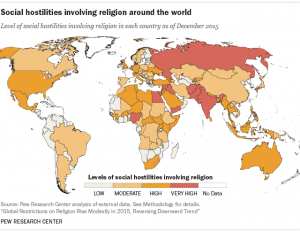
An April 11 Pew Research Center analysis of 198 countries ranked India as fourth worst in the world for religious intolerance. In the country of 1.3 billion, the incidence of hostility related to religion trailed only Syria, Nigeria and Iraq, all places where sectarian violence is widespread.

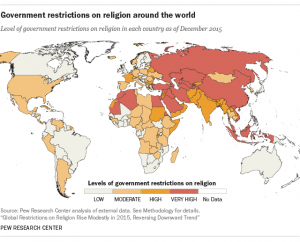
India is not alone in seeing more religious unrest. Globally, Pew says, government restrictions on religion and social hostilities involving religion increased in 2015 for the first time in three years.

Pew analyzed cases that involved hate crimes, mob violence, communal violence, religion-related terror, the use of force to prevent religious practice, the harassment of women for not conforming to religious dress codes, and violence over conversion or proselytizing.

The Hindu vs. Muslim history

Tensions between religious groups—especially Hindus and Muslims—has long divided India, but the rifts have intensified. “[In 2015,] Muslims in India at times experienced attacks by Hindus because of alleged cow slaughter, while Hindus were also sometimes the targets of hostilities by Muslims as well,” Katayoun Kishi, the study’s lead author, told Quartz. “In addition, there were multiple incidents of rioting and mob violence involving the two groups.”

Lynchings of beef-eating Muslims have compromised India’s status as a secular country. But a re-burgeoning Hindutva nationalist agenda has not made even the majority Hindus immune to discrimination, in India or elsewhere. Around the world, Hindus were harassed in 18 countries, fewer places than some other groups. “But the vast majority of the world’s Hindus—95%—live in India, where harassment of Hindus by both government and social groups was reported in 2015,” the study’s authors note. Dalits, the lowest-caste Hindus, were especially ill-treated in society. (Dalits are often secluded from basic government institutions and services, such as education and health care, too.)

National crime statistics in India also indicated that, compared with other caste affiliations, assailants most often perpetrated rape against Dalit women, according to the US State Department’s human-rights country report. Many of the assailants are not prosecuted. On June 24, 2015, attackers beheaded Dalit engineer V. Gokulraj in Pallipallayam, Tamil Nadu, reportedly because of a romantic relationship with an upper-caste Hindu classmate. The primary suspect, local caste leader S. Yuvaraj, absconded for months after the incident. (He later surrendered.)

Real life vs. the law

India’s constitution provides for religious freedom, but the country does not always practice it.

Overall, the Pew study criticizes India for having “high” levels of government restrictions on religion, defined as interference in religion practice or proselytizing, hostility to minority religions and inaction on complaints of discrimination.

“Non-Hindus were particularly impacted by government restrictions in India in 2015,” Kishi said, citing a Chattisgarh high-court ruling that banning non-Hindu religious “propaganda,” prayers and speeches was not a violation of non-Hindus’ constitutional right to preach and propagate their religion.

“Officials of the Bharatiya Janata Party (BJP) at both the central and state government levels made statements that India should be exclusively Hindu,” Kishi added. “Minority communities, including Muslims, Christians and Sikhs, complained of numerous incidents of harassment by Hindu nationalist groups.”

The national government may not have issued any official nationwide diktats about religion, but events leading up to and in 2015 have sparked controversy throughout India. In the western state of Gujarat state anti-conversion laws do not allow people to adopt a religion without permission from the district magistrate, also hampering religious autonomy (paywall). In the north, Haryana decided to include the Hindu holy text, the Bhagwad Gita, in its school curriculum. Mass ghar wapsi (return to Hinduism) ceremonies, organized by a Hindu nationalist wing of the governing BJP, the Rashtriya Swayamsevak Sangh (RSS), are viewed as an attempt to dismantle minority religions.

Pluralism is the panacea to President Trump’s profanity

      Comments Off on Pluralism is the panacea to President Trump’s profanity

Mike Ghouse

President Trump does not care about anyone but himself, he is reckless and insensitive with his words which cause unwanted social hostility between people and nations. He will be gone when his term ends, but we the people will have to live with the consequences of his words and actions.

I stumbled across an article in Times of Israel with the actual title, “When Jews came from ‘shithole’ countries.” What caught my attention was the following sentence, “Sarna and Diner both said that similar fears animated the nativism of the 1920’s and today. In both cases, they said, these derogatory comments were based on a few of the other from a foreign culture, who will disrupt white American society.”

Teresa May, the Prime Minister of United Kingdom expressed the same fear in her speech in Philadelphia to Republicans upon her visit a year ago. She said, “I believe it is in our national interest to do so. Because the world is increasingly marked by instability and threats that threaten to undermine our way of life and the very things that we hold dear.”

Times of Israel wrote, “While congressmen in the 1920s may not have used Trump’s language, they were also opposed to letting in people from so-called undesirable countries — like Italians, Slavs and Jews from Eastern Europe. Chinese immigrants were banned altogether. Senator David Reed, for whom the 1924 law was named, also wanted to let in more immigrants from “Nordic” countries.”

“This prejudice had been around for decades before the 1924 law. A report from 1891 prepared by Senator Henry Cabot Lodge lumped Jews, Italians, Poles, and others into “races most alien to the body of the American people.” Times of Israel.

Recognizing this inherent phobia of a group of people from among the majority of the population, any population for that matter, we wrote at the Center for Pluralism, “The Center is committed to reassuring each other, including the disconnected ones among the White Americans, that together as Americans, we are committed to safeguarding the American way of life. No American needs to worry about losing his or her way of life. As Americans, we uphold, protect, defend and celebrate the values enshrined in our Constitution.

Although no minorities have made any attempt to change the way of life of the majorities, they need to make extra efforts to reassure the concerned group within the majority that they live their lives, and have not, and will not make any attempt to change the Majoritarian lives. Together let’s preserve America’s greatness that we all cherish.

The following speech was written for Hillary Clinton hoping she would deliver it; the full speech is at Huffington Post dated November 6, 2016, two days before the elections.

My priority is to reach out to my fellow Americans who had it good until the disaster from wars brought misery to them; the white Americans. We are going to find ways and means for them to recover from the difficult times they have endured while others Americans have prospered.

You have two stark choices in front of you; one makes the decisions from the seat of his pants. He does not listen to anyone, does not have the support of a single former President nor does he have the advisement of the sane voices. He can bankrupt the nation and walk away with no consequences, but you may be the one who gets stiffed. Your job and your life is an experiment to him, and the safety of our nation will be subjected to his whims.

Believe me, the Black Americans, Jewish Americans, Muslim Americans, immigrant Americans, and all other Americans want each one of us to prosper, particularly the disaffected White Americans. Our prosperity hinges on the prosperity of people around us and prosperity of nations around us. None of us will succeed if some of us are left behind.

I am committed to restoring justice to my fellow Americans who lost their jobs in manufacturing, Americans who live on farms, Americans who do not have an education or technical skills, men and women who are plumbers, electricians, repairmen, drivers, janitors and small business owners, and taking care of them is a priority of my administration. We will restore our glory days, and in the end, no American will be left out.

Pluralism is the panacea

As a society, it is our responsibility to keep law and order and faithfully guard the safety of every citizen. Hate is one of the many sources of disrupting the peace in a society and it is our duty to track down the source of such hate and work on mitigating it. Pluralism is a development of an attitude of respecting the otherness of others and accepting the God-given uniqueness of each one of us. You are who you are and I am who I am; let’s figure it out how to make life easy for both of us.

The Center for Pluralism will become the energy to give a solid cohesive social structure to our nation. By the year 2025, there will not be an office, school, playground, college, restaurant, theater, train, bus or a workplace where people of different faiths, races, ethnicities, and national origins do not work, interact, play, live and marry together. This is bound to create conflicts in airports, public spaces, boardrooms, and in bedrooms as well as places of worship, workplaces, politics, eateries, and schools.

We have a responsibility to shape the future of our society, and we will continue to focus our energies on ensuring a safe America, where no one including your kids, grandkids or yourselves has to worry about his/her faith, ethnicity, race, gender or other God-given uniqueness and live his or her life without apprehensions.

The Center for Pluralism will be an antidote to Anti-Semitism, Islamophobia, Racism, Homophobia, Hindu phobia, Xenophobia, Misogyny and other phobias. Through research and activism, we are establishing a respectful space for the ideals of pluralism with the policymakers, interfaith groups, Republicans and Democrats and of course the media and you!

Mike Ghouse is committed to building cohesive workplaces, societies, and communities and offers pluralistic solutions. He is the founder and president of the Center for Pluralism.

Law of Karma

      Comments Off on Law of Karma

The universe can be broadly categorized into Matter and Life. Every piece of matter is created in balance – example; Jupiter, moon and other things are programmed to function precisely, whereas humans are not, they have a choice to manage the balance for themselves.

Physical and metaphysical things follow certain laws; you reap what you sow, for every action, there is a reaction, the physicists say heat lost in one is gained by the other, the accountants say for every debit there is a credit, and there is always a giver for a receiver. In Hindi/Urdu language it is “Jaisi Karni Waisi Bharni.” You are welcome to share your sayings in the comments below.

No one will escape this truth; it applies to individuals, communities, and nations.

Let me share a few examples; if you receive flowers, your first response is to thank the giver – then the transaction completes and both the giver and receiver feel good about it. When the giver gives you the flower it creates a social debt and it is offset by a thank you, and if you don’t say thanks, awkwardness looms on both sides creating an imbalance. You can go back and apologize for the delay and restore the balance.

If you curse someone, nothing may happen to the other, but something will happen to you, and you lose your own composure, even if you deny that nothing has happened to you. Without a doubt, your spirit is diminished and your capacity to function is lowered. If you keep piling these it will have an adverse effect on your health and a loss of your positive energy. It is like a warm cup of coffee in cold weather that loses its warmth quietly.

You can apply the rule to any situation and it works except a few situations where the criminal seems to get away with murders. That is not entirely true everyone pays for it one way or the other.  The Iraq war caused nearly a million deaths, 9/11 about 3,000 deaths, Hitler and Stalin caused over 10 million deaths… the list is big.  How do they pay for it, how is justice restored?

The only answer I know is what religions have proposed. All the religions say that God will punish them in a variety of ways –in reality, God does not punish anyone, he, she or it has set up a system of laws that operate in the form of the law of nature.

The Dharmic faiths (Hinduism, Buddhism, Jainism and sometimes Sikhism) believe that you will be born again in the lower form of life and the Abrahamic (Judaism, Christianity, Islam),  Bahá’í and other earth-based traditions believe that there is a life after death and everyone’s actions will be accounted for and balanced out.

There is always a way out of it in this life – to repent, to forgive and to apologize. This offers two sets of answers –one is behavior modification and the other is the hope that justice will prevail. Every human seeks justice consciously or subconsciously.

Just remember to seek forgiveness and repent often. Whether it is your patient, doctor, consumer, vendor, boss, employee, contractor, brother, sister, kids or spouse, make a habit of clearing the air frequently. Don’t let the ego hold you down, free yourselves. Seeking forgiveness and forgiveness frees you. Tie the loose ends of life; there is a relief in it.

If you would like to read more about being happy, send an email to speakermikeghouse@gmail.com

One God, the idea

      Comments Off on One God, the idea

It does not matter to me if you believe in one God, two Gods, many Gods or no God. You live your life and I live mine.

The following write up is about understanding the idea of one God. The idea of oneness was the first step towards building one nation and a cohesive society.  There was a need to subscribe the idea of one ultimate God that was common to all. Hinduism calls it Vasudhaiva Kutumubukum – the whole world is one. The Abrahamic faiths believe the entire world came out of one couple; Adam & Eve. So, we are all one.

Each merchant in Mecca, a trading center then had his own Icon representing “his” values, and when the conflicts arose between two merchants, it was their “personal God-Icon” who rescued or won them their battle in business. The conflicts remained a daily routine, sort of the Wild West in America some 200 years ago.

It was a time period when an individual’s greed and his drive to control the resources, wealth and women turned him into pitting his version of God against the others. That was not only in Mecca, but that was the case all around the world then,  and it is the same now.

Subscribing to one common God, with all the non-conflicting attributes packed into one, an abstract idea of God which everyone could relate to was the need of the day. The idea of the oneness of God and oneness of humanity was a source of healing that brought unity among diverse people.

What a relief it was, it freed the men from the blame games and mitigated the mundane conflicts. The wisdom was a panacea to the conflicts among people.

Muhammad (pbuh) received revelations about the oneness of God, and commonness of humanity despite the differences. He understood that very well when he recited God’s words (Quran 49:13) that we were born to a single couple and were made into different tribes, communities, nations, and faiths, and with that uniqueness conflicts are bound to happen and the way to move ahead is to know each other, when we know each other conflicts fade and solutions emerge.

Muhammad revealed this to his family and friends, and they started seeing the value in the conflictlessness of “Your God” versus “My God” and moving on to “our God” – a common denominator God. Thus the word subscribing to the idea of one supreme* God came into being, the Arabic word for submission for peace was “Islam” and the one who submits to the idea of oneness, and conflictlessness was a Muslim, a submitter to harmony.

Prophet Abraham unified people under one God, but the method he chose needs to be studied critically. It has got to be better than what is dished out to us in the scriptures.  He was said to have broken the idols with a hammer to make a point that the idol cannot help itself. My response as a kid was, he had no business doing that.

Prophet Muhammad was ascribed with the same method of dealing with idols but found out that it was not true. When he took over Mecca, he respectfully removed the idols as any new owner would take down the pictures of the previous owners. It was beautifully picturized by Michael Wolfe in his movie – The Messenger. That was my concern before the release of the movie and he allayed those fears.

In his last sermon, Prophet Muhammad (PBUH) delivered one of the best equality statements – that no human is superior or inferior to the other, the words are almost identical to our immortal Declaration of Independence, that all men are created equal. To beef up the idea of equality, he delivered one more statement in Quran – not to treat any prophet above the other, all are equal in the eyes of God

Mike Ghouse
Center for Pluralism

What do we do at the Center for Pluralism?

      Comments Off on What do we do at the Center for Pluralism?

CENTER FOR PLURALISM

http://www.CenterforPluralism.com We define Pluralism as “Respecting the otherness of the other.”

The reason for conflicts between you and me, your culture and mine, your faith and mine, blacks and whites, Republicans and Democrats, your food and mine is because we don’t know each other. What we know about each other are myths created by our parents, teachers, pastors, friends and of course Television.  Instead of finding the truth, we keep pounding them on our memories and it reflects in our responses and I pray that these myths do not become a part of our DNA. Truth brings clarity and freedom.

You are who you are, and I am who I am with our own thumbprints, eye prints, taste buds, religion buds, political leanings and of course, DNA.  We should resist the temptations to deflate, discount or annihilate the other, that temptation is an expression of our inability to deal with the differences. We are better than that, we are capable of handling differences and our focus should be how to co-exist in peace and harmony.  Animals are bestowed with horns, fangs, and paws to fight out their conflicts, humans are blessed with the ability to dialogue and not be at each other’s throats.

Recognizing the human need to be happy, which comes through conflictlessness, we are set out to build a cohesive America, where no American has to live in anxiety, discomfort or fear of the other.


Our programs are designed to bring Americans Together. The center is driven by the fact that the more often people see each other in social, cultural, civic, religious, political and other settings, the stronger the medicine would be against divisiveness, resulting in fewer misunderstandings and misperceptions between fellow Americans.

The Center is committed to reassuring each other, including the disconnected ones among the White Americans, that together as Americans, we are committed to safeguarding the American way of life. No American needs to worry about losing his or her way of life. As Americans, we uphold, protect, defend and celebrate the values enshrined in our Constitution.

We will continue to bring non-stop actions in practicing pluralism in religion, politics, society, and culture and be a catalyst for a safe and a secure America for each one of us.

The Center for Pluralism is committed to building a cohesive America where no American feels excluded. If we can learn to respect the otherness of other and accept the God-given uniqueness of each one of us then conflicts fade and solutions emerge. Our vision is to see each one of us live securely in the pursuit of life, liberty, and happiness

We bring Americans Together in social, religious, cultural, political, civic and other settings. The more we know each other, the fewer the misperceptions would be. At CFP we have programs inplace to achieve this mission.

SHAPING AMERICA’S FUTURE
We are committed to a cohesive America.

Ten years from now, you will not find a place of work, worship, playground, school, restaurant, theater and other places of public gatherings where you will not find people of different faiths, races, and ethnicities interacting, working, studying, intermingling, playing and marrying together. This is bound to create conflicts.

A vast majority of us have heard things about others from our friends, news, social media or our own knowledge of others and we instantly form opinions about others.  As responsible individuals, we must strive to strip stereotyping and build pathways to ensure smooth functioning of our society, whether it is the workplace or our neighborhoods.

We need to reassure each other, particularly the disconnected ones,   that together as Americans, we are committed to safeguarding the American way of life.  No American needs to worry about losing his or her way of life.  Together as Americans, we uphold, protect, defend and celebrate the values enshrined in our Constitution; an insurer of our way of life.

CFP will continue to bring non-stop actions in practicing pluralism in religion, politics, society, and culture and be a catalyst for a safe and a secure America for each one of us as we move through this transition.

As we learn to respect the otherness of others and accept the God-given uniqueness of each one of us, then conflicts fade and solutions emerge.

Our vision is to see each one of us live securely in the pursuit of life, liberty, and happiness.

CFP’S PROGRAMS

We do research, conduct seminars and organize symposiums and workshops on burning topics of the day that affect Americans.  We are all about Research, action, and leadership. Please visit the tabs at www.CenterforPluralism.com

I. RELIGIOUS PLURALISM 

  • Understanding the Essence of Religions, all the beautiful religions
  • Wisdom of Spiritual Masters— A talk series
  • Festival of Faiths—Celebrating all faiths, an annual events

II. POLITICAL PLURALISM

  • Adhoc Seminars with Republicans and Democrats
  • Issue-based Seminars

III. CULTURAL PLURALISM

  • Thanksgiving Celebrations & Awards Night—20 years
  • July 4th—Annual Event
  • Gender Pluralism—Seminars

IV. SOCIAL PLURALISM 

  • Unity Day USA—14th Annual Event
  • Holocaust and Genocides – 13th Annual Event
  • Memorial Day commemoration—Annual Event
  • Veteran’s day—Annual Event

PLURALISM NEWS

  • News items of Pluralism—www.PluralismNews.com
  • Essence of Festivals—write-ups on major festivals

STANDING UP FOR OTHERS

  • www.StandingupforOthers.com
  • Human Rights Activism and religious freedom

Understanding the 
ESSENCE OF RELIGION

Atheism to Zoroastrianism and every tradition in between
13 faiths| 13 workshops | 13 months

When we live as neighbors, fellow workers, students, players, activists and inhabitants of the same city, it behooves us to learn about each other’s beliefs, motivations, moments of celebrations, devotions or commemorations. The more we know about the other, the less
mythical they would become creating a friendly environment for all of us to function effectively in whatever we do.  Knowledge leads to understanding and understanding to acceptance of the otherness of others leading us into tension free and sustainable prosperity.

Please visit our website and participate as a volunteer, sponsor or a donor.  We are a Washington based non-profit 501 (c) (3) organization.

Please donate generously to carry forwards these programs. You can also become a sponsor of one of the programs listed above or special seminars that you feel would help Americans come together.

Please donatehttp://centerforpluralism.com/donate/

MORE DETAILS

The Center for Pluralism

We are pleased to submit the summary of what we do, also included in the summary below is the Muslim Segment of the Center.

Our mission is to build a cohesive America where no American has to live in apprehension, tension or fear of fellow American. Our programs are designed to bring Americans Together.

The center is driven by the fact that the more often people see each other in social, cultural, civic, religious, political and other settings, the stronger the medicine would be against divisiveness, resulting in fewer misunderstandings and misperceptions between fellow Americans. We have programs to bring Americans together,  Attached brochure gives the details – http://centerforpluralism.com/wp-content/uploads/2016/04/4.-CPF-Programs-4-Pages.pdf


WE ARE DOERS:

Please visit our website www.CenterforPluralism.com and browse through nearly 20 programs designed to bring Americans together. We are an organization of activism, and through our actions on the ground, research, publications, Seminars, workshops, TV and Radio appearances we bring results to the community and create a sense of security for every American.

We have defined Pluralism as ‘respecting the otherness of others.’

We are committed to forging a secure environment for all Americans, ultimately the safety of each one of us hinges on the safety of people around us.

PLURALISM AWARDS

The 20th Annual Pluralism Awards, the awards are designed to encourage individuals who respect the otherness of the other, and stand up for the rights of other – Last year’s video: https://www.youtube.com/watch?v=6H9V0h7Jr_M&t=399s

FESTIVAL OF FAITHS

The 2nd Annual festival of faiths will be held on Sunday, December 18, 2017 where we celebrate all religions from Atheism to Zoroastrianism and everyone in between. If we want to develop a sense of oneness with the other with our given uniqueness, we have to witness each other’s celebrations.   Last year’s event: https://www.youtube.com/watch?v=2vAwvoqz01I

HOLOCAUST AND GENOCIDES

The 13th annual reflections on Holocaust and Genocides.  The purpose of the event is education, we have to learn to acknowledge and reflect upon the terrible things we have inflicted upon each other. We have to commit to ourselves to resist the temptations to stereotyping others. We cannot demand peace unless we are peaceful ourselves. Our main anchor event will remain Holocaust and we will be highlighting the plight of Rohingya people and what we can do to prevent evil occurrences.

Invitations are in process to invite the decision makers at the Department of State, Department of Justice and the United Nations.  Details at – www.HolocaustandGenocides.com

UNITY DAY USA

The 14th annual Unity Day USA will be held on September 11, 2018.The idea for Unity Day USA was first conceived on Tuesday, September 11, 2001, and took its current form on Sunday, September 11, 2005. It is an initiative for Americans to come together to stand up for the safety, security, and cohesiveness of America.

On this Unity Day, we the people of the United States of America of every faith, race, ethnicity, culture, and background will gather to express our commitment to co-existence, unity, prosperity and well being of our nation.

Pictures and stories at www.UnityDayUSA.com

THANKSGIVING CELEBRATIONS

The 20th Annual event will be held in November 2018. The purpose of celebrating this event is to thank the creator for helping us learn; to give thanks for the blessed life we all enjoy in these United States of America; to celebrate the diversity of creation; to enjoy the cultural heritage of each ethnic group that makes America; to appreciate and recognize outstanding volunteers in each community; to gather together as Immigrant Americans with born Americans; to bring the new immigrants into our fold and to accept, respect and appreciate each other’s uniqueness. www.ThanksgivingCelebrations.org

UNDERSTANDING RELIGIONS

When we live as neighbors, fellow workers, students, players, activists and inhabitants of the same city, it behooves us to learn about each other’s beliefs, motivations, moments of celebrations, devotions or commemorations. The more we know about the other, the less mythical they would become creating a friendly environment for all of us to function effectively in whatever we do.  Knowledge leads to understanding and understanding to acceptance of the otherness of others leading us into tension free and sustainable prosperity. We will resume workshops on “Understanding Religions, all the beautiful religions” – in 2018.  http://centerforpluralism.com/workshops/

MY DREAM

All good things in society happen with some one’s dream and execution of the same. Here is my dream which is becoming a reality, that one day we will wake up to an America, where no American lives in apprehension, discomfort or fear of the other. It would be a prophetic realization of the vision of our founding fathers, “That all men are created equal, that they are endowed by their Creator with certain unalienable Rights, that among these are Life, Liberty and the Pursuit of Happiness.” And that dream was refreshed by Martin Luther King, Jr. Please join us in achieving that dream for each one of us.

A COMPREHENSIVE PROFILE OF THE FOUNDER:

Mike Ghouse building cohesive societies: http://centerforpluralism.com/wp-content/uploads/2016/04/3.-MikeGhouse-Building-Cohesive-Societies-68-Pages.pdf 

Please visit the homepage www.CenterforPluralism.com for more details or browse through different tabs on our website.

Your donation is appreciated – Americans Together is same as Center for Pluralism
http://centerforpluralism.com/donate/

Valentine Day’s Wishes

      Comments Off on Valentine Day’s Wishes

Love has no bounds

Throughout the history of language, words have taken on new and expanded meanings; Valentine’s Day is no exception.

From an exclusive meaningful rendezvous between two lovers, the Valentine’s Day will morph into an all-inclusive romantic day. It will become a universal affection day within a decade.

Valentine’s Day is a universal expression of affection between two individuals. Love has no bounds; it is between two people in love, husband and wife, mother and son, father daughter, brother sister, brothers, sisters, friends, uncles, aunties, Grandpa and Grandma and any one you care about.

Please feel free to say happy valentine to your sister, mother, brother, daughter, dad, uncle or a friend. It is a much bigger word now than it started out to be. Take them out for dinner and send them flowers to let them know that you care if you are the only one for them at this point in life.

While we Americans express it by presenting red roses to our loved ones, the Filipinos will break another record; the number of people kissing at the same time, Brazil will have another major festival on her beaches celebrating love. You are welcome to share other such expressions.

On the other side of the world, a few frustrated ones with life go to the other end. The right wingers among orthodox Hindus and Muslims will start giving religious tones to it and harass the lovers. They should instead to their place of worship and seek God’s love.

Sadly, some of you are going to feel lonely, if you miss the love in your life; you have an opportunity to fulfill it. There is plenty in you that you can give by feeding the homeless, visiting lonely patients in the hospitals or nursing homes, disadvantage women and children, our veterans… share whatever little you have with them including the time and just listening to them. When a homeless person asks, give whatever you can, that is the most affectionate thing to do, you will enrich yourselves far greater by sharing.

Whenever the word affection comes to mind, I picture my dad and recall the way he called out my Mother’s name Khairun, it was romantic and filled with affection and I have always enjoyed the sound of it, it was simply soothing to hear.

My expressions would be incomplete without honoring the poet of love, Mirza Ghalib, one of the greatest romantic poets of all time who composed his poetry in Urdu/Hindi and Farsi.

Ishk per zor nahin, hai a o aatish ghalib
Ke lagaye na lege, bujhaye no bujhe.

Affection is that flame O Ghalib,
you cannot light it up or extinguish it, it just happens.

Happy Valentine’s Day.

Vandalism

Valentine’s day is a celebration of love, while it is a meaningful day for most people around the world,  it is a day of harassment and vandalism for some. They will go on the streets and destroy the stores that sell Valentine Day cards and flower stores, and if couples are in a park or even a restaurant, those bad guys will harass them as well. I hope the Government of India takes actions against these vigilantes

Republic Day Message from Mike Ghouse

      Comments Off on Republic Day Message from Mike Ghouse

Republic Day Message from Mike Ghouse

Today is India’s Republic Day, the day upon which India’s constitution was adopted. Thanks to Jawahar Lal Nehru, Mahatma Gandhi, Dr. Ambedkar, Sardar Patel, and Maulana Azad for laying a good foundation for our nation and nurturing a pluralistic democracy and placed a good stable sustainable nation in our hands.  Had they not done the right thing, you and I would not have had the freedom and prosperity we have seen. It could have been a tinpot dictatorship banana republic, thank God they steered us in the right direction.

Now it is the duty of our current Prime Minister Narendra Modi to dutifully sail the ship in the same right direction set by our founding fathers.  This is what they would say to the Prime Minister in handing over the nation, “Manzil pay aaya mulk her bala ko taal ke, Hum laye hain toofan say kishti nikal ke, es desh ko rakhna mere bachcho sambhal ke.”

I am proud of my mother country India and my homeland America and I will defend both nations with my last breath. We are inherently a democratic people with responsible capitalistic economies.* The strength of a nation lies on two solid feet to stand firmly – one is economic justice, i.e., sab ka Vikas and the other is social cohesion, i.e., sab ka Saath.  It is how different groups function together for the common good without fighting among themselves.

At this time, India is struggling to stand on her feet – we do not have sab ka Saath neither Prime Minister Modi is doing anything to bring the communities together, let alone speaking out against the division.  Sab Ka Vikas is a forlorn thing – when someone has seen 3000% increase in his wealth while the majority is going down, it is nothing but Kuch ka vikas.

Both my nations are working with the idea of democracy against temptations to rule people. You rule people when you don’t believe they have the God-given intelligence to make fair decisions for themselves. That is what the British thought of us that we were incapable of ruling ourselves, which that SOB Churchill had verbalized and wanted to divide us and continue to rule, but failed… He laid the eggs that are hatching in the form of homegrown divisive Indian individuals. The only way to counter is to lay good eggs to overwhelm the bad eggs. Let each one of us do more good to one and all to reverse the fall.

Ask not what Modi can do for India; ask yourselves what you can to restore dharma (sab ka saath). And I ask each one of you to ask yourselves, what have you done to keep the nation together? What have you done to guard the freedom of fellow Indians? What have you done, to tell the truth? What have you done to develop harmony among Indians? What have you done to preserve the freedom of all? Remember, your freedom hinges on the freedom of others around you, if you bully others, you will always live in apprehension and fear of the other at the end no one will live in peace.

If you are a Muslim (or anyone from the minority communities), have you invited a Hindu to a dinner at your home and vice versa? Do you have at least 5 friends from other communities? If not, why not? Are you a contributor towards India’s Vikas? If not, it is not too late to make a pledge to do the right thing – to respect every fellow Indian and let him or her live his life in the pursuit of his happiness. Live your life and let others live theirs.  Let everyone have the God-given freedom to breath, eat, drink, wear or believe whatever the hell he or she wants. Be a contributor to the common good, it brings Mukti from ill-will.

India’s culture has been around for 5000 years and every now and then it has faced temporary setbacks, and what we are going through now is a temporary face. Indians will wake up and restore India’s glory of freedom, democracy, and pluralism.

India’s pluralistic Ethos:

My Dear Fellow Indians,

We are Indians and nothing but Indian.

An Indian is an Indian is an Indian, period.

As a nation, collectively we are Adivasis, Atheists, Bahais, Bos, Buddhists, Christians, Dalits, Hindus, Jains, Jewish, Muslim, Sikhs, Tribals, Zoroastrians and every possible grouping. We are Brown, Black, White, Yellow and green with envy, magar phir bhi dil hai Hindustani.

Our Motherland is represented by every race, nationality, ethnicity, language, culture, and religion. We see God as one, none and many; and in every form; male, female, genderless and non-existent, being and non-being, nameless and with innumerable names.

We are proud of our heritage – a multi-faith, multicultural, multi-regional and multi-linguistic society, where we have come to accept and respect every which way people have lived their lives. For over 5000 years, India has been a beacon of pluralism – it has embraced Islam, Christianity, Judaism, Baha’i and Zoroastrianism to include in the array of the indigenous religions; Hinduism, Tribal traditions, Jainism, Buddhism, and Sikhism.

We may want to consciously start thinking and acting as one people, one people within a nation and a community and one people globally. It’s like home when we are conflict free.  I do hope each one of us purges any bias towards the other, there is joy in being free from ill-will. Try to be free from this day forward… free from anything that prevents you from being a part of the whole.

Our combined philosophies believe in one world ; Hinduism describes the world as Vasudaiva Kutumbukum, the whole world is one family, the idea of Ek Onkar(one) in Sikhism, you are all created from the same couple as Quraan puts it and Jesus embraced every one regardless of who anyone is… similar philosophies are grounded in all our religions.

A few don’t follow their own heritage and resort to thievery, loot, murder, terrorism, rioting, rapes, infanticide and other evils that destroy the fabric of the society,  but a majority of every group goes about their own way, living their life with struggles and ease and don’t even bother others. We should build upon the 99% of the population and not on the less than 1% that does not follow any principles.

On this day, and every day from here forward, make a pledge to yourselves to talk about in terms of “I am an Indian” – and not Malayalee, Gujarati, Bengali, Punjabi…. or Hindu, Muslim, Sikh, Isaee. Don’t expect others to jump and say the same, give them the time and if you are consistent for at least a year, you will see others emulating you.

India led the way to the freedom movement, since 1947 every country has been liberated from colonialism. Indian democracy is a shining example to the world, where the people have peacefully transferred the powers.

We are inherently secular and economically capitalistic. We believe in “live-and-let-live” lifestyle, which is the essence of capitalism.  We respect everyone’s right to eat, drink, wear or believe in whatever they want after all God created each one of to be a unique being with our own thumbprint, eye print, taste buds, religious buds, and DNA.

Through the years we have expressed the highest degree of maturity on handling extreme situations; the more divergent opinions we hear, the larger our heart grows, the bigger our embrace would be and we can cushion more differences. Let’s continue to honor the concept that there is always another side to the story, as finding the truth is our own responsibility. I am proud of my heritage and am proud to be an Indian-American.

…..

Indian Pledge of Allegiance

With a belief that every Indian wants justice and demands a fair treatment of every one of the 1.1 billion Indians; rich or poor, connected or not, we must come to grips with the social and community life to create an exemplary India, that will become a model nation in the world.

We have to figure out how to co-exist with least frictions. It is in your interests, my interest, and everyone’s interest to have justice, which gives birth to sustainable peace and prosperity

We have to find solutions for people who go to the extremes; be them be Buddhist, Christian, Hindu, Jain, Muslim, Sikh, Zoroastrian or other, hoping they would recognize the God-given space to each one of us and eventually see the benefits of co-existence.

I propose that the parliament of India introduce a bill for every political, cultural and religious organization in India to register with the Home Ministry, state their purpose, list their assets for public scrutiny, list the membership roster to be updated annually. Include a modified version of the 7 items into Indian Penal Code, and make it into the law to punish the violators of the law.

Patriotism should be defined in terms of what you do to uplift the hopes of people, in terms of education to all, jobs to as many as we can in each successive year, home for every human, and a better lifestyle to every Indian.

Every public office holder from the Peon to the President of India and everyone in between must take this pledge and live by it. Violation should disqualify him or her from holding the public office. Let it be monitored publicly.

  1. I pledge allegiance to India, indivisible nation that stands for liberty and justice for all.
  2. I pledge that I honor and treat every Indian with “full” dignity.
  3. I pledge that all individuals would be treated on par.
  4. I pledge that I will treat all religions with equal respect, equal access, and equal treatment.
  5. I pledge that I will oppose any act that treats any Indian less than myself.
  1. I Pledge that I will work for an India, where every individual can live with security and aspire for prosperity.
  1. I pledge that I will protect, preserve and value every inch of India and every human soul in India

This would be the first step towards ensuring a Just, peaceful and prosperous India, that can sustain its progress and peace.

Click and enjoy:

Our National Anthem National Anthem 2 Twenty Patriotic songs on click \India’s Map

Jai Hind

Mike Ghouse

Committed to cohesive societies

www.MikeGhouse.net

http://mikeghouseforindia.blogspot.com/

PATRIOTIC SONGS

……………………………………………………………………………………………………………….

Jai Hind

* The song, hum laye hain toofan say kishti nikal kehttps://www.youtube.com/watch?v=ddrx8288qwA

* History of Republic Day by Dr. Frank Islam athttp://mikeghouseforindia.blogspot.com/2018/01/india-can-be-standard-setter-for.html

* Responsible capitalism is based on economic and social justice and is sustainable, where as abusive capitalism takes advantage of the weak and will collapse one day or the other cause a loss to everyone- Rich getting richer is not bad, but if they become rich beating up on the disadvantaged, it is bound to shatter causing every one severe pain.


Mike Ghouse is a speaker, thinker and a writer on pluralism, politics, peace, IslamIsrael,Indiainterfaith, and cohesion at workplace and society. He is committed to building a Cohesive America and offers pluralistic solutions on issues of the day. He believes in Standing up for others and a book with the same title is coming up. Mike has a strong presence on national and local TV, Radio and Print Media. He is a frequent guest on Sean Hannity show on Fox TV, and a commentator on national radio networks, he contributes weekly to the Texas Faith Column at Dallas Morning News; fortnightly at Huffington post; and several other periodicals across the world. His personal site www.MikeGhouse.net indexes all his work through many links. Most of his work is at www.CenterforPluralism.com

Padmaavat – My personal take on the movie

      Comments Off on Padmaavat – My personal take on the movie

I saw the movie in 3D IMAX Theater. Here are my impressions, to get a full picture, I urge you to read the links appended below, without which, any opinion would be incomplete.

It is a well-made movie, the palace sets are incredible, and even the jungle scene, the falls and the battlefield were all done fairly well. However, Bahu Bali still leads the pack in extraordinary sets and graphics.

Bhansali has done something no other movie producer has done for Indians, particularly Hindu Indians. When we see Mogul Movies or Roman Movies we walk out impressed with the grandeur of the lifestyle of those kings. Bhansali has filled that vacuum for Hindus of India by making grandeur sets, palaces, and clothes.  Modi tried to paint ancient India with Superior surgeries and vimanas that most Indians did not buy, Bhansali has created a positive glorious past for the Hindu Indians in his two movies I have seen and has done a good job of it. Every community needs to feel proud of the past.

The movie is a typical formula film set in the historical mix of fact and fiction. It is all about a man chasing a woman. He is obsessed with her beauty and will do anything to get her. The movie can be seen from many dimensions including the one-sided romance, How many of us will put everything at our disposal to get that woman or man depending on our gender?  It can be seen as another Laila Majnu, Shereen Farhad and Romeo Juliet story, but one-sided romance.

Alauddin is shown as a nut case in the movie and that is the prerogative of the producer, he has got to make money and he did not claim it to be factful either, it is not documentary but a piece of fiction and imagination of a writer.

When the king gets the Queen’s arrow in his heart, in the beginning, they remove it together and within no time he proposes to marry her and she accepts… that was little too quick and too unbelievable for the Desi American youth, where it takes time to know each other and have to date for a while before taking that step.  No wonder, there was a gasp in the audience (Desi Kids) and someone made a comment in our row in the theater as unbelievable. But it happens in India, in our youth we easily fell in love with someone in school or college and loved her or vice versa without even talking to her or him. It is an Indian movie and that is our culture.

Alauddin’s obsession of Padmavati reminded me of a song line from film Gumraah,  “Kitne diwane thay hum, aap ko pane ke liye” from the song Aap aaye to khayal-e-dil-e nashaad aya. Fortunately, Alauddin never got in a position to say, ” Ghair ka ho ke bhi a husn mere saath to hai.”

I did not see this as an anti-Muslim film at all.  In fact, if someone were to be upset, it should be the Brahmans for the role of Brahmachari. He reminded me of Poornayya (Tippu Sultan) and Mir Jaffar.  There were three clear instances where he is blamed for the fall of Chittor, and all the chaos he created in revenge.  Maya Angelou had said, if you insult someone in public, that person will be obsessed with revenge, in fact, most people hold onto grudges of insult and patiently wait to get even.

To the credit of Bhansali, he has evoked reason and logic in many spots. When Padmavati gives a speech to the Dasis about Jauhar, a good dialogue was delivered.  She says something to the effect of the conflicts between Ram and Ravan, Kauravas and Pandavas and then Khiljji and Rajputs is another one. Conflicts are nothing new.  Bhansali reduced the conflict to like any another conflict. He must be lauded for doing that.

There was another dialogue where Alauddin says that the time for expanding the boundaries of his Sultanate is paused now, and Padmavati is his focus.  Bhansali could have him recite that Krishna Deva Raya (Vijaynagar empire), the Pallavas, The Guptas, Mauryas and Rajput Kings all expanded their boundaries and I have done my share. Of course, it is his film. Samajne wale zaroor samjehingey, jo na samajh hain, they will always get it what they are set to get; ill-will.

Another good scene is Padmavati’s call to escape when Alauddin’s army was praying Namaz. Reverse the scenario, the Karni Sena and BJP would have created havoc.

Alauddin asked the colors be applied to him because the day was Holi – it is a good gesture of respect for the Hindu culture. Reverence for Hinduism is different than fighting for Land or the Beauty.  I don’t know if that touch of a message is enough for people to see it or more needed to be done.

Bhansali is just showing what happened once in our history. The practice of Sati was real but is not practiced anymore. There is severe opposition to it, please read the article by Swara Bhasker listed below

Bhansali did not claim this to be facts of history, he acknowledges right at the beginning that it is a fiction adopted from Malik Muhammad Jayasi’s novel. We have seen so many movies, and no matter who makes it, it will be always be tainted by the producer. I would have been upset and taken some action if he had claimed to be history or facts of history. He did not.

Overall it is a good movie.

The struggle to present correct picture continues unabated, and no doubt it is frustrating. Restoring confidence and hope in the new generation of Muslims is still the need of the day. Each one of our kids is capable of doing anything they want if they set their minds to it.

Related:

Padmaavat – where are Muslim Protests – Aijaz Zaka Syed
https://mikeghouseforindia.blogspot.com/2018/01/padmaavat-where-are-muslim-protesters.html

Padmaavat – Story of Vagina by Swara Bhasker
https://mikeghouseforindia.blogspot.com/2018/01/padmavat-reduced-to-vagina.html


Padmaavat – story behind story by Dr. Syed Amir
https://mikeghouseforindia.blogspot.com/2018/02/padmaavat-story-behind-story-when.html

Mike Ghouse
(214) 325-1916
Washington, DC

Toyota Super Bowl Commercial is insensitive

      Comments Off on Toyota Super Bowl Commercial is insensitive
February 5, 2018, Washington, D.C. – We welcome the Toyota Commercial played during the Super Bowl, it was aimed to be inclusive of all Americans but it failed to do so, someone fumbled.  At the Center for pluralism, we take an exception to this commercial.
The interfaith movement needs to be lauded, as it brings Americans together. However, in the commercial played during the 52nd Super Bowl on Sunday, February 4, 2018,  leaders of a few faiths forgot about people of other faiths,  that is not inclusion, interfaith means all faiths, not just the Abrahamic faiths.
Mike Ghouse, President of the Center asserted, “As a Muslim, I was elated to see the commercial, but by the time the commercial was over, I was sourly disappointed to see the exclusion of people of other faiths, the commercial is perceived to be inclusive, it is not, we the people are not in this together.”
Where was a Native American, Hindu, Sikh, Bahá’í, Zoroastrian, Wicca, Jain, Shinto, Atheist, Confucius or the other in the commercial? Aren’t they consumers of Toyota?
We urge Toyota to make a new commercial, where Americans of all hues are represented, you can place 30 different Americans in two rows of stadium chairs or whatever the background for a fleeting 3 seconds, each American will recognize his or her inclusion. Inclusion is good for business.
The Center for Pluralism is committed to building a cohesive America where no American feels excluded. If we can learn to respect the otherness of other and accept the given uniqueness of each one of us then conflicts fade and solutions emerge.
Mike Ghouse, President
Center for Pluralism
Washington, DC

India in California Text books – Hindutva influence

      Comments Off on India in California Text books – Hindutva influence

I have supported the rights of Indians to correct the wrongs of the written history. It is not good for Hindu American children to grow up reading negative things about their heritage, The question is can we change the facts of history, while the facts continue to happen?

For children growing up in the United States, it is embarrassing for them to read about the mistreatment of Dalits, and now the others who are not Hindus.  It does not fit with the American way of life. Of course,  Muslims are not free from it either with Triple Talaq and polygamy and other practices going on in India.

Caravan paper writes,

……………………………….

“The camp led by the HAF and HEF, which claimed to represent the Hindus in the US, had criticised the textbooks for content that was deemed derogatory to Hinduism, including a flippant question that was criticised as mocking (“How’s Your Karma Doing?”), and a photograph of cows eating trash.”

Almost all of the edits that came from the Hindu side—many of which sought to erase or whitewash more unsavoury aspects of Hinduism and South Asian history, such as patriarchy and caste—were rejected.

In one proposed edit, the report reads, “This is a subject of controversy, not settled fact. Correction: Remove mention of ‘Sarasvati’ and refer to it as ‘Indus Valley Civilization.’” In another comment, the panel was even more emphatic: “The Sarasvati River has never been proven to exist.””

……………………………….

Anyone visiting India sees the cows eating trash, I was there in August last year and took several pictures with disgust. The cow we ‘claim’ to revere so much has to endure such humility.  That is a fact of life and we cannot whitewash it unless we change how cows are treated in India. India is one of the top three exporters of beef and the owners of the slaughterhouse are Hindus and Jains, the ones who oppose beef in India, but the bulk of the sellers of cattle to slaughterhouse are Hindu farmers, it will hurt their livelihood. If non-Hindus quit eating beef, the Indians farmers will be committing mass suicides as selling the cattle is their livelihood and the numbers are rising.

If there is a proof of the Sarasvati River, and references to it, it should be called Indus Sarasvati Civilization, if there is no proof, no need to change facts of history.

Almost all of the Muslim, Christian and Dalit Indians are for Hinduism, but not for the Radicals among Hindus in the guise of Hindutva, an extremist political ideology whose founder believed in Hitler and many members of the RSS continue to praise Hitler. These men, in the name of Hinduism (not really) are harassing fellow Indians, and the man on the top does not say much – all he has to do is say that there will be punishment for anyone who harasses or discriminates fellow Indian. Hinduism does not teach one to discriminate, harass or lynch, then the PM claiming to be Hindu should speak up. Can the HAF and HEF speak about the values of Hinduism that goes against the very organization they have been supporting?

If Hindus are harassed in America, you can count on Muslims to speak up, would the HAF guys do it? Do they represent Hindus or the radical Hindus? HAF has to come out clean with statements as to whose interests they represent – Hinduism’s or Radicals among Hinduism?
 http://standingupforothers.blogspot.com/2012/04/standing-with-hindus.html and this petition urging Toyota to be inclusive, exclusion splinters the society, inclusion bonds people and nurtures goodwill.  The petition – http://chn.ge/2sc6e7v

If the Dalits and non-Hindus are treated like what India’s constitution calls for; that is Dalit women are not the object of sex for the upper caste Hindu men; and they are not entitled to the Dalit women and they are not raped and hung on trees, and if a Dalit groom rides a horse and the upper caste accepts it instead of beating the groom up; if a Muslim is not lynched for eating meat (suspecting it beef) and if Christian nuns are not raped and harassed. If HAF and HEF can focus on correcting this non-sense in India, then the California textbooks should be corrected.

The extremists assume that they can destroy others, but in the end, they are part of the destruction. If the corporations see the injustice, discrimination, and mistreatment of Indians by Indians, they will stop investing in India and start backing off. All of us will lose.

Sam Brownback, the new Ambassador for religious freedom said it in one sentence if a nation oppresses a minority, they will take it for a while, but eventually, revengeful minds will start scheming and everyone will be hurt. Justice is the foundation of successful societies. America is a shining example of it. It is in the interest of every Indian to be just and seek justice for others.

We cannot dupe our children, teach them one thing but when they visit India, they see it differently. The Indians parents look stupid to the American Indian Children. Over the years, I have asked some of my extremist fellow Indians to show their comments to their children and ask them honestly to grade them on the scale of the stupidity of their statements.

I expect the communalists at SAJA to pounce on me, and will try to give my comment a communal color, their brains are trained to be communal, I hope someday God helps clean their minds and start thinking Indians as Indians and not Dalits, Hindus, Muslims, Christians, Jains, Sikhs, Buddhist, Bahai, Jews, Zoroastrians, and Tribals.

Mike Ghouse
# # #

# # #


Reference – http://www.caravanmagazine.in/vantage/californias-textbooks-war-reveals-mounting-influence-hindutva-united-states

Courtesy Caravan


The Latest Skirmish In California’s Textbooks War Reveals The Mounting Influence Of Hindutva In The United States

By ARIA THAKER | 7 February 2018


COURTESY SOUTH ASIAN HINDUS FOR ALL

SAHFA criticised the textbooks for not complying with a set of curricular guidelines—called the “framework”—that the California board of education had finalised in May 2016. The review of the framework, too, saw a tussle involving largely the same players, and SAHFA’s camp had then come out ahead.

PreviousNext

 408  379

Print | E-mail |

Single Page

Early in the morning, on 9 November 2017, hundreds of people flooded the headquarters of the California department of education. They lined up in the building’s glass atrium, waiting to testify before the members of the state board of education. That day, the board was scheduled to vote on whether various new history and social-science textbooks were going to be adopted for use in California’s government-run schools. The board president reportedly stated that the hearing was “the longest in the history of the state Board of Education.”

A point of contention before the board that day was the material in these textbooks that referred to South Asia. Thenmozhi Soundararajan, an anti-caste activist who testified that day, estimated that of the roughly 500 people present, 470 were there to discuss concerns related to this material. A key concern—among others, such as the description of the Indus Valley Civilisation and the origins of Sikhism—was the representation of caste in Hinduism.

The people present, and their concerns, can be divided into two broad camps. One camp was led by South Asian Histories for All, an inter-caste, multi-faith group of activists that Soundararajan founded. SAHFA cited inaccuracies regarding caste and other issues in the textbook material, and called for a delay on the books’ approval so that they could be submitted for further editing. The other camp, which Soundararajan said greatly outnumbered SAHFA, was led by the Hindu American Foundation(HAF), a non-profit that claims to advocate for Hindus in the United States, and the Hindu Education Foundation (HEF)—an outfit affiliated with the Hindu Swayamsewak Sangh, the US-based wing of the Rashtriya Swayamsewak Sangh. This camp, too, was heavily critical of certain parts of the textbooks, which they felt denigrated Hinduism. They did not, however, ask for the board’s decision to be delayed.

After the public hearing, the board voted to reject two of the 12 textbooks up for discussion, both published by Houghton Mifflin Harcourt. The camp led by the HAF and HEF, which claimed to represent the Hindus in the US, had criticised the textbooks for content that was deemed derogatory to Hinduism, including a flippant question that was criticised as mocking (“How’s Your Karma Doing?”), and a photograph of cows eating trash. The board approved the rest of the books, which had been released by other well-known publishers, among them National Geographic, Pearson and McGraw Hill.

Even the textbooks that were approved, however, had at least some material that Hindu groups had called derogatory. Nevertheless, the Hindu camp celebrated the board’s decision as a victory. HAF and HEF both posted an identical statement on their respective websites, titled “Hindu Americans Win Historic Victory in California Textbooks.” SAHFA, meanwhile, posted a press release titled “History Under Attack: New California Textbooks Fail to Protect Targeted Minorities, Cave to Hindu Nationalists.”

SAHFA criticised the textbooks for not complying with a set of curricular guidelines—called the “framework”—that the California board of education had finalised in May 2016. The framework was determined after many months of edits submitted by members of the public, and a review process facilitated by a team of educational experts called the Instructional Quality Commission, or IQC. According to state procedure, the framework dictates the content that should appear in textbooks.

The finalising of the framework, too, saw a tussle involving largely the same players: HEF and HAF on the Hindu side, and SAHFA and many leading South Asianist academics in opposition to them. In the final framework, SAHFA’s camp had come out ahead. Almost all of the edits that came from the Hindu side—many of which sought to erase or whitewash more unsavoury aspects of Hinduism and South Asian history, such as patriarchy and caste—were rejected. Several of SAHFA’s edits, including ones that affirmed the existence of caste oppression, were accepted. SAHFA’s assumption at the time, Soundararajan said, was “that our job was done.” But in early 2017, when she saw the textbooks, “it was just like night and day from what was approved in the framework and what got implemented.”

The state board’s decision in November marked a dramatic reversal of fortunes between the two camps, which, if the board had more diligently followed its procedure, would likely not have occurred. An examination of this procedure reveals the pressure that Hindu groups exerted on the publishers, such as directly participating in their review processes and embroiling them in litigation, to influence the final outcome. Soundararajan noted, “Our assumption was that the State Board of Education was going to be protecting the adherence to the frameworks, and they were negligent in that.”

A clear example of the influence that the Hindu groups exerted over the publishers is that Murali Balaji, HAF’s director of education, is credited in the National Geographic textbook as a “reviewer of religious content.” During the debate on the framework, HAF had asked that the phrase “communities outside the jati system, the ‘Untouchables,’” be changed to “socially ostracized and economically disadvantaged communities”—a revision that would have scrubbed the sentence of any reference to caste. The proposed change was officially rejected, and SAHFA’s request to have the line edited to include the term “Dalit” was incorporated into the final framework.

But the final textbook matches HAF’s suggested edits more closely than it does the framework text. For example, while the framework had described the Dalit community by name, the approved National Geographic textbook fails to do so. It notes, “At the bottom were slaves, laborers, and artisans … Many centuries later, another group developed that was considered even lower.”

The Hindu camp’s edits, particularly on issues concerning the representation of caste, appeared to mirror the positions adopted by Hindutva groups in India. For instance, Sanskar Bharti, a cultural affiliate of the RSS, was reportedly seeking to “correct the lies” about ancient Hindu scriptures being “anti-Dalit and anti-woman.” The outfit sought to remove references to caste discrimination from the Manusmriti, and noted that interpretations of the text arguing that it was anti-Dalit were “propaganda.” The Hindu camp’s edits during both the framework and textbook review sought a similar erasure of references to caste.

A similar deviation from the framework was evident in National Geographic’s discussion of Sikhism. The framework makes clear the fact that Guru Nanak, the founder of the Sikhism, “was a social reformer who challenged the authority of the Brahmins and the caste order.” The National Geographic textbook, however, does not include any mention of Nanak’s opposition to the caste system.

During the framework review, HAF, HEF and the Uberoi Foundation—another Hindu group—had all submitted edits for this line that would have erased its reference to caste. According to Jaideep Singh, an academic who specialises in the study of Sikhs in the United States and is active with SAHFA, Nanak’s opposition to caste was “very central to Sikh identity.” The Hindu groups, he added, “viewed it as a personal attack on Hinduism, when in fact it’s who we are as a people.”

National Geographic did not respond to questions about Balaji’s involvement in the textbook-drafting process. When I asked Suhag Shukla, the executive director of HAF, about Balaji’s role as a reviewer on the textbook, she told me that not only had HAF worked with National Geographic, but they have “worked with most of the major ones”—publishers—in California and in other states. “California, being the largest purchaser of textbooks, is an important state, but these narratives are found in textbooks across the United States.” Samir Kalra, a senior director of HAF, affirmed that the foundation had worked directly with all the publishers except for Studies Weekly and McGraw Hill.

A similar influence seems to have been exercised over Pearson’s textbooks. In several instances, the textbooks used the phrase “Indus-Sarasvati Civilization” instead of the term “Indus Valley Civilization”—the phrase used in the framework, which holds the current academic consensus. “Sarasvati” refers to a river from Hindu myth, whose historical existence has not been documented in reputed scholarship. California’s framework contains no usages of the phrase “Indus-Sarasvati Civilization.”

During the adoption process, the drafted textbooks undergo an initial review by a panel of experts, followed by a final review by the IQC, which takes the review panel’s recommendations and the publishers’ responses into consideration in its decision. In its report, the review panel flagged Pearson’s mentions of the Sarasvati River and requested they be edited or removed. In one proposed edit, the report reads, “This is a subject of controversy, not settled fact. Correction: Remove mention of ‘Sarasvati’ and refer to it as ‘Indus Valley Civilization.’” In another comment, the panel was even more emphatic: “The Sarasvati River has never been proven to exist.”

Pearson doubled down in the face of this criticism, and in doing so, revealed that they had received extensive input from Hindu groups on this matter. In a hearing held at the department of education in late September, where the review panel’s suggestions were discussed, Luess Sampson-Lizotte—the vice president for product development for humanities and science at Pearson—requested that the panel’s recommendations about the Sarasvati be rejected. Sampson-Lizotte said, “We worked closely with national and local Hindu scholars to ensure that we created the highest-quality program for California students. The requested changes are supported by the Hindu American Foundation, the Hindu Education Foundation, and Hindupedia.” (Hindupedia is a website that also submitted detailed feedback to the textbooks. In one edit, they claimed that a description of the caste system was a “very stereotypical and negative remark, because these rigid customs were observed only in a few parts of India in late medieval times.”)

The IQC was unmoved by Pearson’s appeal. In a report by the commission in October, they upheld all of the review panel’s requests to have references to the “Indus-Sarasvati Civilization” removed or changed to the “Indus Civilization.” Pearson subsequently revised its textbook in accordance with the commission’s directions.

While the IQC may have been successful at removing the term “Indus-Sarasvati Civilization,” it retained a lot of commentary that perpetuates caste erasure, similar to the type that the Hindu groups pushed for during the framework-review process. For example, one Pearson textbook notes that the caste system

brought both costs and benefits. For instance, the system limited people’s individual freedom. The patterns of their lives were fixed at birth. However, some believe that the caste system helped India develop. They feel that it brought stability to Indian society. Indian goods became famous because caste members perfected their skills. The system also allowed different groups to follow their own beliefs.

It is difficult to imagine such apologia for oppression being peddled in a US textbook’s chapter about chattel slavery or South African apartheid.

The Hindu camp has also pressured the publishers by involving them in litigation. A key player in this aspect is the group California Parents for the Equalization of Educational Materials, or CAPEEM, which describes itself as “a group of parents residing in the state of California” that is “deeply concerned about the indoctrination of Abrahamic religions and the negative descriptions of Hinduism in the History and Social Science textbooks of our state.” CAPEEM has been active for over a decade—in 2006, it filed a lawsuit against many members of the board of education and the department of education, alleging that the adopted history textbooks put forth “derogatory and unequal treatment of the Hindu religion.” The case ended in a settlement in 2009, with CAPEEM withdrawing the suit, but receiving $175,000 from the department of education and the board.

HAF, too, filed a suit against the state board of education in 2006. The foundation claimed that the process that the board had undergone to review textbooks for sixth-grade students was not “fair and open,” and the judge ruled in HAF’s favour.

In February last year, CAPEEM filed another lawsuit, alleging that Hinduism received “unfair and unconstitutional treatment” in the textbooks. In its press release about the complaint, CAPEEM noted that the adopted framework “devotes almost half the discussion of Hinduism to the caste system, which it portrays as a supposed Hindu religious belief.” Last year, the board of education moved a motion before a California court to dismiss the case, but the judge declined to dismiss one of four claims against the state.

Soundararajan said that the CAPEEM suit had been an effective way for the Hindu camp to apply pressure to the process. “Their goal is to basically hang the threat of litigation over this round”—the editing of the textbooks—“so that the state board of education is afraid to actually advocate on behalf of people that aren’t Hindu,” Soundararajan said. “When the publishers would ask the state of California for verification about what was happening, they wouldn’t respond.” She continued, “I think that was specifically because they don’t want any correspondence on the record saying that they may have helped in addressing the issue of caste, because they don’t want to be sued later.” While reporting this story, I reached out multiple times to several individuals affiliated with the department of education—including people on the board and in the IQC—but never received a response.

CAPEEM and HAF’s abilities to initiate such suits, which generally involve paying handsome legal fees, point towards the steep differential in resources between the two camps. While SAHFA is a coalition of volunteer activists, HAF and HEF are both tax-exempt non-profits that receive considerable money in donations. According to HAF’s 2016 tax return, the organisation had net assets of over $3.2 million—a jump of $1 million from the previous year. HEF is not a registered non-profit, but the Hindu Swayamsewak Sangh is, and HSS’s tax returns state that the organisation is “doing business as” the Hindu Education Foundation. The HSS’s 2016 tax return shows that the organisation has assets of over $3.1 million. Curiously, HEF seems to have minimal staff managing these funds—according to its 2016 return, the organisation’s only salaried staff member is Saumitra Gokhale, who supposedly works an average of 40 hours a week and makes $30,000 as a “yoga instructor.” (In an article on the website of Organiser, the RSS’s English-language mouthpiece, Gokhale is listed as a “Pracharak for America continent.” A January 2016 article in the Indian Express identifies him as the current global coordinator for the HSS).

Although Shukla and Kalra told me that HEF has also long been a major player on the California textbooks issue, it is difficult to pinpoint the on-the-ground work that the organisation has done, and who has been executing it. What is visible, though, is the organisation’s virulent digital footprint. For instance, a post on HEF’s website calls SAHFA “a fringe Hinduphobic group” that “tried to derail the textbook adoption process.” HEF also compiled a list of responses to SAHFA’s requested edits, in which it demonstrates even more fervour to whitewash caste than HAF. The list states, for example, that “The ‘caste system’ itself, as many scholars of colonialism have shown, is a product of Europe’s colonial encounter.” In response to a requested edit that would detail the fact that Dalits were “forced to do work considered impure,” HEF wrote that “the suggested edit has political overtones and also is not age appropriate for middle school children.”

HAF seems keen to hide, or at least wash its hands clean of, the fact that HEF is closely linked with the HSS. When I asked Shukla, HAF’s executive director, whether the organisation had ever worked with the HSS, she said no—and that, at the most, the HSS might have signed one of HAF’s many open letters. “We’ve worked with HEF,” she added. Kalra, the senior director, described HEF as “a community-based group” that HAF had worked with “throughout the years.” I then asked him who I should get in touch with from HEF, but he was not able to give me a single name. When I asked him whether the HSS was involved with HEF, he said, “I have no idea about that.” Shukla and Kalra seem to be either woefully ill-informed about their close partners, or intent on remaining evasive about any connections that HAF might have with the Sangh. HEF did not answer my request for an interview.

During the dispute over framework content, academics played a particularly influential role. Unified under the banner of the “South Asian Faculty Group,” many professors signed a letter that detailed the reasons why many of the edits proposed by the Hindu groups were ahistorical and ideologically motivated. A similar letter, with over 90 signatories, was submitted this year, endorsing the specific edits requested by SAHFA.

The Hindu camp, too, assembled a team of academics this year, who submitted their own letter. It was written primarily by Jeffery Long, a professor of religion and Asian studies at Elizabethtown College, who has previously worked with HAF on a report about anti-Hindu bigotry online. With almost 40 signatories, Long’s letter criticised some of the textbooks for their “underlying Orientalist narrative” and their tendency to put forth “inaccurate and unfavorable comparisons of Hinduism with other religions.”

But over a lengthy Skype interview with me, Long took a far more moderate tone than that used by HAF, HEF and many others in the Hindu camp. Long said while he thought some of SAHFA’s edits were “Hinduphobic,” he also found some of them “quite reasonable”—in particular, their requests to include descriptions of caste oppression. He also criticised the Hindu camp for not engaging in productive dialogue with the opposition. “I think one thing that militates against dialogue is when any critical discussion of Hinduism or Hindu practices is immediately dismissed as Hinduphobic,” he said. “That’s not the way forward. The way to cure a problem is first to acknowledge you have a problem.”

As this controversy unfolded, other Hindu organisations also came to the fore to express that HAF and HEF did not speak for them. Sadhana, a non-profit that describes itself as a “coalition of progressive Hindus,” posted a statement announcing their solidarity with SAHFA, noting, “Sadhana rejects attempts to erase or minimize caste in accounts of Hinduism.”

Hindus for Justice, a “network of Hindu progressives across the United States,” posted a statement titled “Just Say No To Hindu Fragility.” It read, “Many Hindus aren’t thin-skinned and afraid. Many of us are able to find pride in what’s best about Hinduism, while still respecting others, acknowledging our faults, and embracing complexity.” The statement continued, “That’s why we’re proud to stand with South Asian Histories for All … We’re proud to stand on the right side of history.”

Aria Thaker is a copy editor at The Caravan.